
Weighting Key Results and Aligned OKRs: A Practical Guide
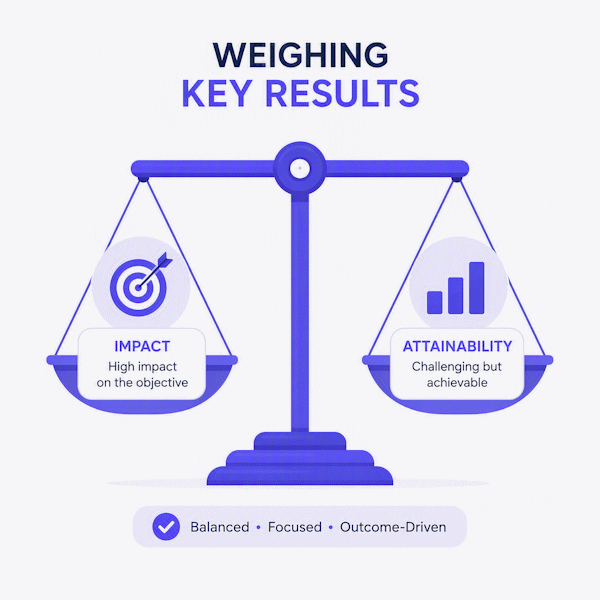
An Objective usually has two to four Key Results attached to it. In most cases, treating them as equally important is fine and simple. But sometimes one Key Result genuinely matters more than the others, and averaging them all equally hides that. This is where weighting comes in. Used sparingly, it can make your OKR scoring more honest, a nuance John Doerr discusses in Measure What Matters, his book on how OKRs are scored in practice. Used everywhere, it turns a simple system into a spreadsheet exercise nobody wants to maintain. Here is a practical way to think about it.
What Weighting Actually Solves
Imagine an Objective to "Improve customer onboarding" with three Key Results: reduce time-to-first-value, increase onboarding completion rate, and improve the onboarding survey score. If the completion rate is by far the most important driver of retention, but it only counts for a third of the overall score, a team could hit the other two Key Results easily and still look like they succeeded, even if completion rate barely moved. Weighting fixes this by giving the completion rate a larger share of the overall Objective score, so the number actually reflects what mattered.
Default to Equal Weighting
For most teams, especially those newer to OKRs, equal weighting is the right starting point, in line with Google re:Work's guide to setting goals with OKRs. It's simpler to explain, simpler to calculate, and avoids turning every planning session into a debate about percentages. Only introduce weighting when you have a clear, specific reason: one Key Result is meaningfully more important than the others, and treating them equally would give a misleading picture of success. If you can't articulate that reason in a sentence, you probably don't need weighting for that Objective.
Keep the Weighting Simple
When you do weight Key Results, resist the urge to get precise about it. Something like 50/30/20 across three Key Results is easy to understand and reason about. Chasing exact percentages, like 47/31/22, adds a false sense of precision to something that is ultimately a judgment call. The goal of weighting is to roughly reflect priority, not to build a formula. If you find yourself debating decimal points, that is a sign the process has drifted away from what OKRs are meant to be: a tool for focus, not an accounting exercise.
Should Aligned OKRs Inherit the Weighting?
When a team's Key Result is aligned underneath a organization-level Objective, a natural question comes up: should the weighting cascade down too? In practice, the answer is usually no, and trying to force it usually causes more confusion than clarity. A team's own OKRs should be weighted based on what matters most for that team's context, not based on a percentage inherited from a different level of the organization. Alignment is about connecting the dots between what a team is doing and the bigger picture, not about mechanically propagating a scoring formula down through every layer.
Weighting Should Never Replace Judgment
Even with weighting in place, a number alone rarely tells the full story of whether an Objective succeeded. A weighted score of 85% might reflect genuine, meaningful progress, or it might reflect one easy Key Result dragging up two that quietly stalled. Weighting is a helpful input into a conversation about progress, not a replacement for that conversation. Use it to make check-ins and retrospectives more accurate, not to remove the human judgment that OKRs are supposed to support.
How Easy OKR Handles Weighting
Easy OKR supports Key Result weighting where you need it, but it does not force it on every Objective. Most teams using Easy OKR keep weighting equal by default and only turn it on for the handful of Objectives where it genuinely changes the story. That matches the broader philosophy behind the tool: give teams the option for more precision when they need it, without making it mandatory overhead for everyone else.