
The Different Types of Key Results (and When to Use Each)
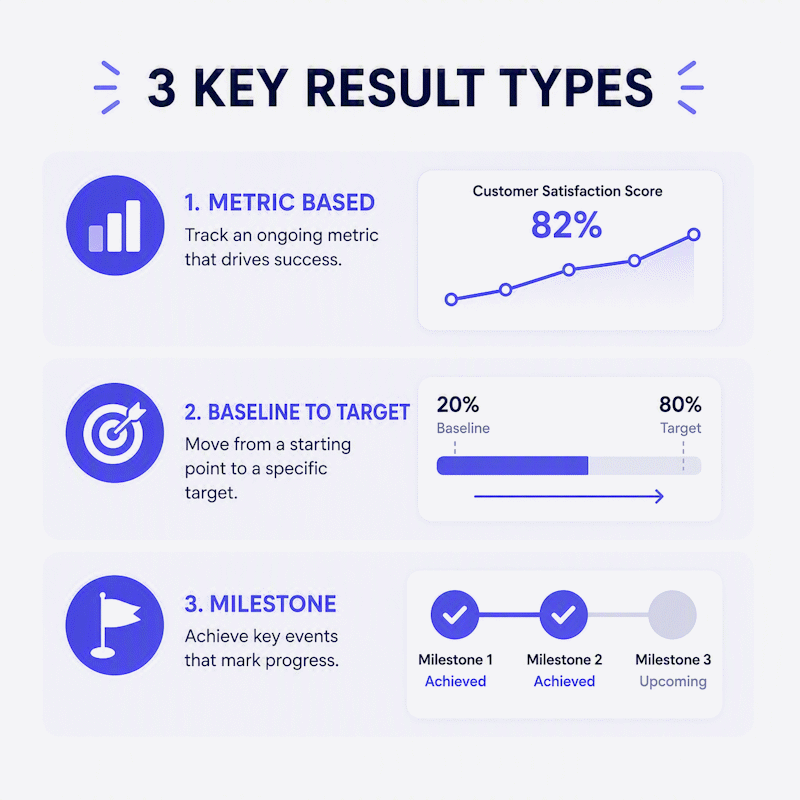
A lot of OKR guidance treats Key Results as if they only come in one flavor: a number that goes up. In reality, teams run into goals that don't fit that mold cleanly, launching a new product, finishing a redesign, closing a big partnership. Forcing every one of these into a percentage metric can produce a Key Result that technically works but doesn't actually capture what success looks like. Knowing the main types of Key Results, and when each one fits, makes it much easier to write ones that actually work.
Metric-Based Key Results
This is the classic form: a number that moves from a starting point to a target, like "Increase monthly recurring revenue from $40,000 to $60,000" or "Reduce average support response time from 6 hours to 2 hours." Metric-based Key Results are ideal when you have a clear, ongoing number that reflects the health of what you're trying to improve. They work especially well for growth, retention, quality, and efficiency goals, where the underlying metric already exists and just needs to move in the right direction.
Baseline-to-Target Key Results
A close cousin of metric-based Key Results, baseline-to-target Key Results are worth calling out separately because they're specifically useful when you're improving something that doesn't have a natural "up is good" direction, like a survey score, an error rate, or a specific ratio. The key is being explicit about both the starting point and the target: "Improve onboarding survey score from 3.2 to 4.2 out of 5." Naming the baseline matters because without it, a Key Result like "improve survey score to 4.2" doesn't tell you whether that's a stretch or a formality.
Milestone-Based Key Results
Not everything worth tracking is a smooth, continuous number. Some things are genuinely binary: a product either launches or it doesn't, a partnership either closes or it doesn't. For these, a milestone-based Key Result works better than forcing an artificial percentage onto something that's really a yes-or-no outcome. "Launch the new mobile app in the App Store and Google Play" is a perfectly good Key Result, even though it doesn't have a numeric target attached. The trick with milestone-based Key Results is to make sure the milestone is genuinely unambiguous. "Make progress on the mobile app" is not a milestone, it's vague. "Launch the mobile app publicly" is.
Combining Multiple Milestones Into One Key Result
Sometimes a single outcome is really made up of several discrete steps, and it can help to track progress across them as a percentage of steps completed, rather than one big binary flag. "Complete 4 of 4 planned integrations with major CRM platforms" is a milestone-based Key Result that still gives partial credit for progress along the way, which is often more useful for weekly check-ins than a single all-or-nothing milestone sitting at 0% for two months and then jumping to 100%.
Avoid the Trap of Forcing Everything Into a Percentage
A common mistake, especially in tools that only support numeric Key Results, is inventing an artificial percentage for something that's really a milestone, like tracking "launch the new website" as a made-up completion percentage based on how many tasks are done. This can quietly turn a Key Result into a disguised project plan, which is a common and well-documented OKR pitfall covered in Google's own guide to setting goals with OKRs. It's better to be honest about the type of Key Result you're writing than to force every goal into the same shape for the sake of consistency.
How Easy OKR Supports Different Key Result Types
Easy OKR supports both metric-based and milestone-based Key Results natively, so teams don't have to force a launch or a milestone into an artificial percentage just to fit the tool. The goal is to make it just as easy to write "Launch v2 of the product" as it is to write "Grow signups from 1,000 to 2,500," because both are legitimate, common ways a Key Result can look.