
Alignment from Company to Team
Alignment means teams understand how their outcomes contribute to company direction. It does not mean every key result must be cascaded top-down. True alignment happens when teams can see the connection between their work and organizational priorities, while maintaining ownership and autonomy in how they achieve results. Getting this balance right is one of the biggest factors in whether OKRs feel useful or feel like extra paperwork.
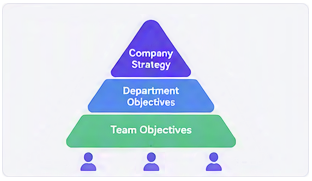
Alignment is understanding, not paperwork
Many organizations treat alignment as a structural problem. They draw a tree, link every team goal to a leadership goal, and assume the picture proves that everyone is pulling in the same direction. The picture proves very little. A team can be perfectly linked on paper and still have no idea why their work matters this quarter.
The better test is simple. Can each person describe the organization's top priority and explain where their own work fits? If yes, you have alignment, with or without a diagram. If no, adding more links will not fix it. What fixes it is a short, clear set of organizational priorities that leaders repeat often enough that people can say them from memory.
Three alignment models
- Independent team OKRs aligned by theme: Teams set their own OKRs that support company themes without direct parent-child relationships. Leadership publishes three or four priorities, and each team decides how to contribute.
- Cascaded objectives with local key results: Company objectives cascade down, but teams define their own key results. The what is shared, the how stays local.
- Shared key results across departments: Multiple teams contribute to the same measurable outcome. One team owns the number, the others commit to their part of it.
None of these models is universally correct. Harvard Business Review's guidance on setting OKRs for teams takes a similar view: most organizations end up using a blend, applying tighter cascade for a handful of critical initiatives while leaving most teams free to set their own path. The goal is always the same: make sure people understand why their work matters, not to force every team into an identical structure.
When to use each
Use independent models for fast-moving teams where innovation and speed matter more than tight coordination. This works well in product development and growth teams. Choose cascaded models for highly coordinated transformations like organization-wide system migrations or brand repositioning. Use shared key results when cross-functional contribution is mandatory, such as launching a new product that requires engineering, marketing, and sales alignment. Many organizations start with independent OKRs and only introduce cascading once a specific initiative genuinely needs it.
You can also mix models in the same quarter. One critical program might use a strict cascade while every other team works from themes. That is not inconsistency. It is matching the structure to the level of coordination each piece of work actually needs.
Set OKRs from both directions
Pure top-down goal setting produces OKRs that nobody believes in. Pure bottom-up goal setting produces a list of team wishes that never adds up to a strategy. The practical answer is to work from both directions and meet in the middle.
A workable sequence looks like this. Leadership publishes the organizational priorities first, in plain language, before teams start drafting. Teams then write their own proposals for how they will contribute. Leaders and teams meet to review the drafts together, looking for gaps, overlaps, and priorities that no team picked up. Teams revise and commit. In Measure What Matters, John Doerr argues that a healthy OKR system has a large share of goals set from the bottom up, because people commit far more strongly to goals they helped write.
This process should take a week or two, not a month. If your goal-setting cycle runs longer than that, the problem is usually too many review rounds, not too little alignment.
Align sideways, not only downward
Most alignment advice focuses on the vertical line between leadership and teams. In practice, more work stalls because two teams at the same level never talked. Marketing plans a campaign for a feature engineering has not scheduled. Support gets a wave of questions about a change nobody told them about.
Horizontal alignment is often the higher-value conversation. Before the quarter starts, have each team share their draft OKRs with the teams they depend on and the teams that depend on them. Ask two questions. What do you need from us? What are you assuming we will deliver? Write down the answers as dependencies with names and dates. A shared key result is the strongest form of this, but even a short dependency list prevents most of the surprises.
Check alignment without forcing a cascade
You don't need a diagram of parent-child links to know if teams are aligned. Ask each team to explain, in one sentence, how their OKRs support an organizational priority. Research from MIT Sloan Management Review found that how consistently managers can explain their team's priorities is one of the strongest predictors of real strategic alignment. If they can't answer clearly, either the OKR needs to change or the priority hasn't been communicated well enough. This quick test works for any of the three alignment models and takes far less time than mapping out a full cascade.
Transparency does much of the work here. When every team can see what the other teams are working on, people spot mismatches themselves without waiting for a leader to notice. MIT Sloan research on goals that are transparent and openly discussed points the same way. Goals that are visible and talked about frequently drive execution better than goals that are carefully specified and then filed away.
Signs alignment has broken down
Alignment problems rarely announce themselves. These are the signals worth watching for:
- Two teams are solving the same problem in parallel and neither knows about the other
- A team's OKRs would look exactly the same if the organizational priorities changed
- People describe their objective by naming a project instead of naming a result
- Nobody can say which priority would lose if two of them conflicted
- Check-ins focus on updating links and percentages rather than on decisions
Any one of these is a prompt for a conversation, not a reason to redesign the whole model. Usually the fix is a clearer priority from leadership, or one honest discussion between two teams.
Avoid over-cascade
Too many parent-child links can reduce ownership and speed. When every team OKR must ladder up to a company OKR, you create dependency bottlenecks and slow decision-making. Alignment should improve focus and clarity, not create reporting overhead. Start with loose alignment through themes and only tighten connections where coordination is truly essential. If teams spend more time updating links than doing the actual work, the alignment model has become the problem instead of the solution. A lighter structure that people actually maintain beats a detailed one that gets ignored after the first month.
A useful limit is to keep the structure no deeper than two levels for most work. Organization to team is enough in the large majority of situations. A third or fourth level usually means the OKRs have turned into a task list wearing a different name.
Keep it alive during the quarter
Alignment set in January will drift by March. Priorities shift, a customer commitment lands, a project slips. That is normal, and the response is to talk about it rather than quietly let the OKRs go stale.
Build one short alignment moment into your existing rhythm. In the mid-quarter review, ask each team whether their OKRs still support the top organizational priority, and whether any dependency has changed. Christina Wodtke makes a similar point in Radical Focus. The weekly rhythm of committing and reviewing is what keeps goals connected to reality, not the document you wrote at the start.
If you are starting out, keep it simple. Publish three organizational priorities, let teams write their own OKRs against them, ask every team to explain the connection in one sentence, and only add formal links where two teams genuinely share an outcome. You can always tighten the structure later. Loosening it once people have learned to work around it is much harder.
References
- No One Knows Your Strategy — Not Even Your Top Leaders — MIT Sloan Management Review
- With Goals, FAST Beats SMART — MIT Sloan Management Review
- Use OKRs to Set Goals for Teams, Not Individuals — Harvard Business Review
- John Doerr, Measure What Matters (Portfolio, 2018)
- Christina Wodtke, Radical Focus (Cucina Media, 2016)