
Making Key Results Measurable
A key result must be measurable. If you cannot tell whether you achieved it, it is not a key result. Vague statements like "improve performance" leave too much room for interpretation. This article shows you how to turn ambiguous goals into clear, trackable outcomes that your whole team can rally around.
The three types of key results
- Growth metrics: Increase X from Y to Z (e.g., revenue, users, NPS)
- Threshold metrics: Achieve X by date (e.g., launch product, hit 90% uptime)
- Milestone metrics: Complete X by date (e.g., ship feature, run pilot)
Most objectives work best with a mix of these types. Growth metrics show steady progress over time, threshold metrics confirm you crossed an important bar, and milestone metrics prove a specific deliverable actually shipped. Picking the right type for each key result makes weekly tracking much simpler.
Use baseline and target
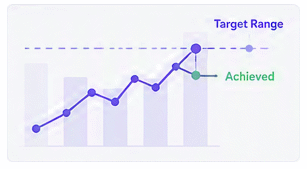
A good key result includes both a starting point (baseline) and a goal (target). This makes it easy to track progress and understand what success means. It echoes a core finding from goal-setting research by Edwin Locke and Gary Latham: specific, quantified goals produce clearer effort and better performance than open-ended ones. Without a baseline, a number like "reach 10,000 users" tells you nothing about how much effort it actually takes to get there. Always write down where you are today before you decide where you want to be.
Examples:
- Increase monthly active users from 5,000 to 10,000
- Reduce customer support tickets from 200/week to 100/week
- Improve app performance score from 65 to 85
How many key results per objective
Each objective should have two to five key results. A single key result creates a single point of failure and hides trade-offs between different parts of the work. More than five spreads focus too thin and makes weekly check-ins slow and tedious. Two to five key results usually cover the different angles of an objective, such as growth, quality, and speed, without overwhelming the team that owns them.
Avoid binary key results
"Launch the new feature" is not a good key result because it's binary — you either did it or you didn't. Instead, focus on the outcome: "Achieve 20% adoption of the new feature within 30 days of launch." Binary key results also make weekly updates boring, since there is nothing new to report until the very last day.
Set stretch targets
OKRs should be ambitious. A good target is something that requires effort and focus, not business-as-usual. Google's own guidance on stretch goals suggests aiming for 70-80% achievement as success, not 100%. If your team consistently hits 100% of every key result, the targets were probably too safe. Ambitious targets encourage creative problem-solving instead of routine execution, and they help you discover what your team is truly capable of achieving.