
OKRs vs OGSM: The Closest Framework to OKRs
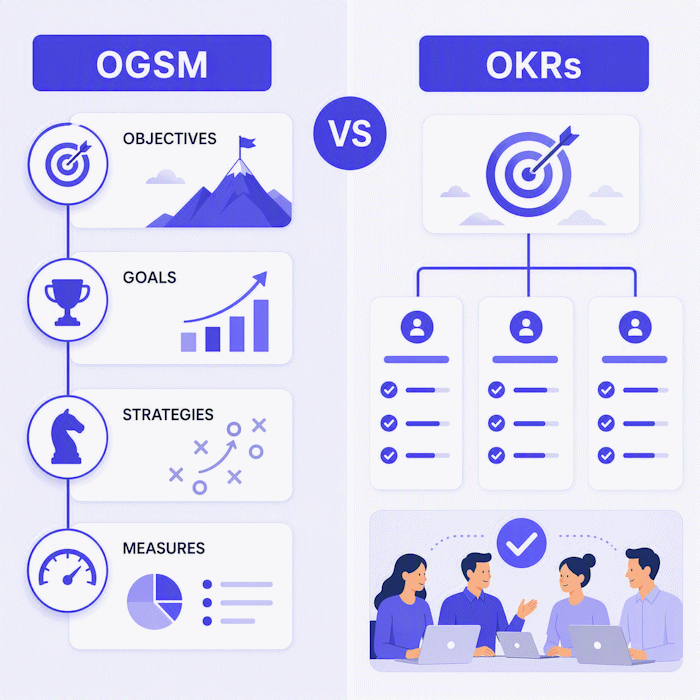
Most comparisons of OKRs focus on KPIs or the Balanced Scorecard, but there's a lesser-known framework that's arguably closer in spirit than either: OGSM, which stands for Objectives, Goals, Strategies, and Measures. It traces back to Japan in the 1950s and was later refined and popularized by Procter & Gamble, decades before OKRs existed, and it's still used at large consumer goods and manufacturing companies today. If you've never heard of it, it's worth understanding, because it solves a real gap that OKRs sometimes leave open.
What OGSM Actually Contains
OGSM has four layers. The Objective is a single, qualitative statement of the long-term aim, often written to last several years, not just a quarter. Goals are the specific, quantitative targets that define what achieving the Objective looks like. Strategies describe the broad approaches the organization will take to hit those goals. Measures are the specific metrics used to track progress on each strategy. Structurally, it reads almost like an OKR framework with an extra layer inserted in the middle, and it shares roots with Hoshin Kanri, the Japanese strategy-deployment practice built around the same idea of cascading a long-term aim down into measurable, trackable pieces.
The Key Similarity: Both Force Measurable Targets
OGSM and OKRs share the same core discipline: a goal isn't allowed to just be a vague aspiration. Every Goal in OGSM needs a Measure attached, the same requirement OKRs place on Key Results attached to an Objective. Neither framework tolerates "improve customer experience" as a standalone goal without a number behind it. This is the part of OGSM that will feel immediately familiar to anyone who already runs OKRs.
The Key Difference: OGSM Explicitly Names the "How"
This is where the two frameworks really part ways. OKRs deliberately leave the "how" out. A Key Result tells you the outcome you're aiming for, not the method you'll use to get there, that's left to the team's judgment and adjusted as circumstances change. OGSM's Strategies layer bakes the "how" directly into the plan. That can be an advantage in industries where the path to a goal is well understood and doesn't change much quarter to quarter, manufacturing efficiency or supply chain optimization, for example. It can be a disadvantage in fast-moving environments where locking in a strategy at the same time as the goal removes flexibility the team might need later.
The Key Difference: Timeframe
OGSM's Objective layer is typically long-range, often spanning several years, with Goals and Strategies operating underneath it on a shorter cycle. OKRs are almost always short-cycle end to end, typically quarterly. This makes OGSM naturally better suited to long-range strategic planning exercises, the kind of multi-year vision work a leadership team might do once a year, while OKRs are built for the faster iteration and adjustment that fits a quarter-by-quarter operating rhythm.
When a Team Might Prefer OGSM
OGSM tends to fit organizations that want a single document capturing the full chain from long-term vision down to specific tactics, particularly in industries with longer planning horizons and more predictable execution paths. It can also appeal to leadership teams doing an annual strategic planning exercise who want the strategy and the goal captured together rather than left as separate conversations.
When OKRs Are the Better Fit
OKRs tend to work better for organizations that need to adapt quickly, startups, scaleups, and any team operating in a market that shifts often enough that locking in a strategy for a full year feels risky. By separating the outcome (the Key Result) from the method (left to the team), OKRs make it easier to change course mid-quarter without needing to rewrite the entire plan. This is also part of why OKRs have spread so widely in tech and fast-growing companies specifically, environments where the right strategy this month may not be the right strategy next month, even if the underlying goal hasn't changed.
They're Not Mutually Exclusive
Some organizations use a lightweight OGSM-style document for annual strategic direction and then translate that into quarterly OKRs for execution. That combination can work well: OGSM answers "where are we going and broadly how," while OKRs answer "what will we prove this quarter." For a small or fast-moving team, though, the simpler answer is usually to skip the extra layer and go straight to OKRs, which is exactly the workflow Easy OKR is built around: a small number of Objectives and measurable Key Results, revisited every quarter, without the added planning overhead of a formal Strategies layer most small teams don't need.