
MBO vs OKRs: What's the Difference?
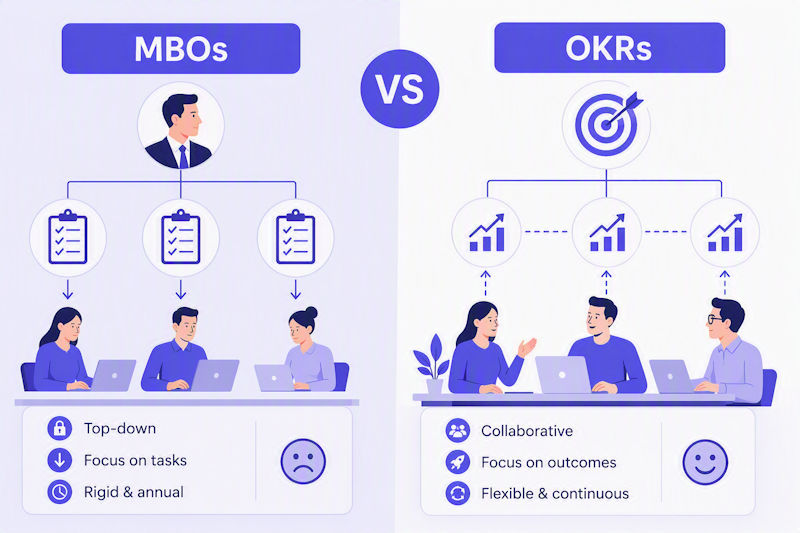
Long before OKRs became a Silicon Valley buzzword, there was Management by Objectives, or MBO, a framework popularized by management thinker Peter Drucker in his 1954 book The Practice of Management. OKRs didn't emerge from nothing. Andy Grove, who developed the OKR system at Intel, was directly influenced by MBO and built on top of it, a lineage Harvard Business School's Working Knowledge has traced in detail. Understanding what changed between the two explains a lot about why OKRs work the way they do today.
What MBO Actually Is
Management by Objectives is built around a simple idea: managers and employees agree together on a set of objectives, and performance is then evaluated against how well those objectives were met. The core insight, radical for its time, was that employees should have a say in setting their own goals rather than simply being told what to do. That collaborative goal-setting piece is genuinely still present in OKRs today, and it's one of MBO's most lasting contributions to how organizations think about goals.
Where OKRs Diverge: Frequency
MBO objectives were typically set annually, reviewed annually, and tied closely to the yearly performance review cycle. OKRs, by contrast, run on a much shorter cadence, usually quarterly, with weekly or biweekly check-ins along the way. This difference alone changes how the two frameworks feel in practice. A goal you revisit once a year can drift far from reality before anyone notices. A goal you check in on every week stays a living, current thing, adjusted as circumstances change rather than locked in place for twelve months.
Where OKRs Diverge: Transparency
MBO objectives were traditionally private, negotiated between an employee and their manager, visible mainly to the two of them. OKRs are usually organization-wide and visible to everyone. Any employee can see the CEO's Objectives and how the team next door is progressing on theirs. This visibility is a deliberate design choice, meant to help people connect their own work to the bigger picture and to make it easy to spot when two teams are unintentionally working at cross purposes.
Where OKRs Diverge: Compensation
This is probably the sharpest practical difference. MBO objectives were commonly tied directly to performance ratings and pay decisions, hitting your objectives was often part of the compensation formula. OKRs, at least as designed by Grove and later popularized by Google, are explicitly meant to be kept separate from compensation. The reasoning connects back to ambition: if a goal affects your paycheck, you'll set a goal you're confident you can hit. If it doesn't, you're freer to aim higher and accept that you might land short. This single change in incentive structure is a big part of why OKRs tend to produce more ambitious targets than MBO objectives typically did.
Where OKRs Diverge: Outcomes Over Objectives Alone
MBO often stopped at defining the objective itself, without a strict requirement to attach a measurable way of knowing whether it was achieved. OKRs formalize that second half explicitly, every Objective needs Key Results, specific measurable indicators of success. This forces a level of precision that MBO, in its original form, didn't always require.
Why the Lineage Still Matters Today
Knowing this history is useful for a practical reason: it explains why some organizations that adopt "OKRs" quietly slide back toward MBO-style habits, annual goal-setting, private objectives, and scores baked into performance reviews. Those habits aren't necessarily wrong for every organization, but they're not really OKRs anymore, they're MBO with different vocabulary. If your organization wants the real benefits of the OKR approach, faster iteration, transparency, and ambition without compensation risk, it's worth being deliberate about keeping those specific differences intact rather than drifting back toward the older model out of habit. Easy OKR is built around the OKR side of that lineage by default, quarterly cycles, organization-wide visibility, and scoring kept separate from performance reviews, so teams don't have to fight their own tooling to stay on the OKR side of the line.
References
- The Practice of Management — Peter Drucker
- The History and Influence of Andy Grove — Harvard Business School Working Knowledge