
OKRs vs the Balanced Scorecard: How They Compare
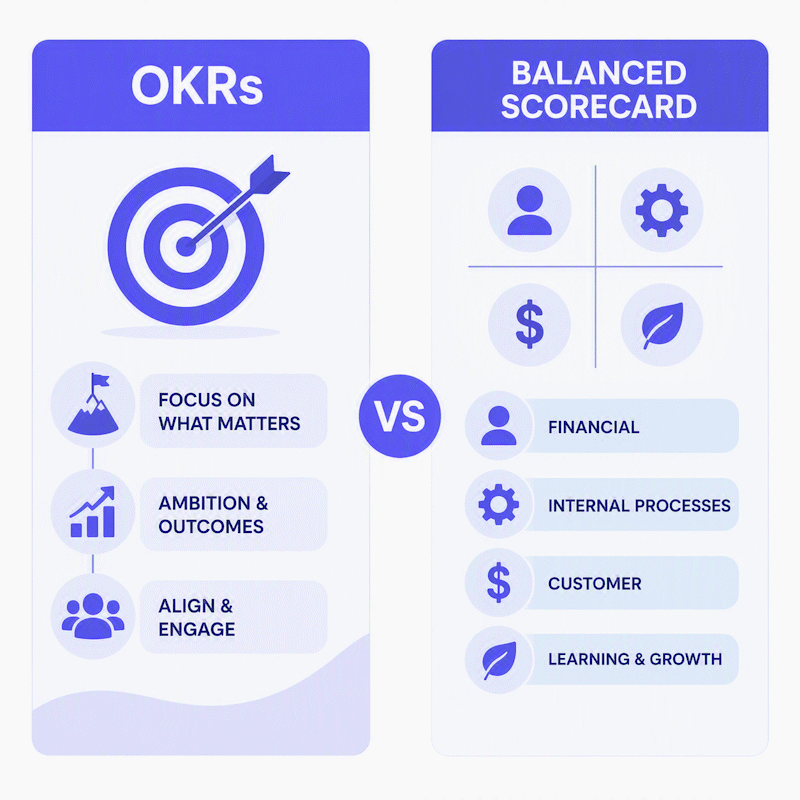
OKRs and the Balanced Scorecard both try to solve the same underlying problem: turning strategy into something a team can actually act on day to day. But they come from different eras, were designed for different kinds of organizations, and work quite differently in practice. Understanding the difference helps you pick the right tool, or the right parts of each.
What the Balanced Scorecard Is
The Balanced Scorecard, introduced by Robert Kaplan and David Norton in their 1992 Harvard Business Review article, was developed as a response to organizations that managed almost entirely by financial metrics. It adds three more perspectives: customer, internal process, and learning and growth. The idea is that strategy should be measured from multiple angles, not just the bottom line, and that each perspective should have its own metrics and targets.
The Balanced Scorecard tends to be a longer-term, more structured management system. It's often built to run for years, reviewed quarterly or annually, and maintained by finance or strategy teams as part of formal enterprise governance.
What OKRs Are
OKRs, popularized by Andy Grove at Intel and later widely adopted in tech, are built for a faster cadence. Instead of a fixed set of perspectives, you set a handful of Objectives, qualitative statements of what you want to achieve, paired with measurable Key Results that define what success looks like. OKRs are usually set quarterly, reviewed often, and designed to be rewritten as priorities shift, as laid out in Google's guide to setting goals with OKRs.
The Core Difference: Cadence and Flexibility
The Balanced Scorecard is built for stability. Its categories don't change often, and its metrics tend to track ongoing health across the business. OKRs are built for change. They're meant to spotlight what matters most right now, which might be completely different next quarter. If your organization operates in a fast-changing market, that flexibility is often a bigger asset than a comprehensive, stable measurement system.
The Core Difference: Structure vs Simplicity
The Balanced Scorecard's four fixed perspectives give it structure and completeness. Every important angle of the business gets a home. That completeness comes at a cost: it takes real effort to set up, and it can be heavy for a smaller organization to maintain. OKRs deliberately trade some of that completeness for simplicity. You're not trying to measure every dimension of the business, you're trying to focus attention on the few things that matter most this cycle.
Can You Use Both?
Some organizations use the Balanced Scorecard for long-term, organization-wide health metrics, while using OKRs underneath it to drive quarterly execution on specific priorities. That combination can work, but it also adds complexity, and for a smaller organization it's often unnecessary. Most startups and scaleups get more value from picking OKRs alone and keeping the system light, since they don't yet have the scale or the dedicated strategy function that the Balanced Scorecard assumes.
Which One Should You Use?
If you're a large, established organization that needs a comprehensive, stable measurement system across finance, customers, process, and people, the Balanced Scorecard has real staying power. If you're a smaller, faster-moving organization that needs to focus attention on a handful of priorities and adjust every quarter, OKRs are the simpler and more practical fit. This is exactly the gap Easy OKR is built to fill: a lightweight way to run the OKR side of that equation without the overhead of a full strategy management system.