
Realigning OKRs After a Change in Leadership
A new leader almost always means a shift in priorities. Whether it is a new CEO, a new VP of Product, or a new head of Sales, they arrive with their own read on what matters most, and that rarely lines up perfectly with the OKRs the team set a few months earlier. This puts teams in an awkward spot. Do you finish out the current OKR cycle as planned, or scrap it and start fresh? Neither extreme is usually right, a tension Harvard Business Review's research on leadership transitions also points to. Here is a practical way to realign OKRs after a leadership change without losing the discipline your team has already built.
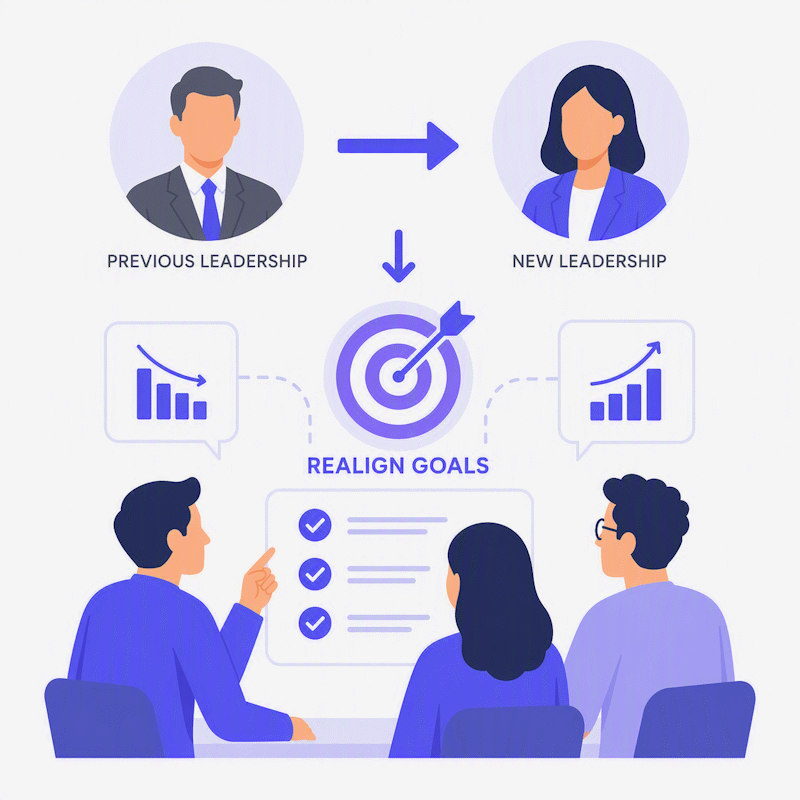
Don't Throw Out the Whole Process
The instinct when a new leader arrives is sometimes to pause everything and wait for direction. Resist that. The OKR process itself, setting clear goals, tracking progress, checking in regularly, is not something you need to rebuild. What might need to change is the content of the goals, not the habit of setting and tracking them. Keep the cadence running while the substance gets updated underneath it. Teams that pause the whole process "until things settle" often find that months go by with no clear goals at all, which is far more disruptive than a mid-cycle adjustment.
Give the New Leader Time to Form a View, But Not Too Much
A brand new leader usually cannot articulate a fully formed strategy in their first week, and asking them to rewrite company OKRs immediately would force a rushed, poorly informed set of goals. At the same time, waiting three months for a fully baked strategy leaves teams working against an outdated Objective the new leader does not actually believe in. A reasonable middle ground is to give the new leader two to four weeks to listen, review the current OKRs, and form an initial view, then run a focused session to adjust or replace the top-level Objectives based on what they have learned. This lines up with the "listening tour" period Michael Watkins recommends in The First 90 Days, his well-known book on how new leaders should pace early decisions.
Separate What Changes From What Doesn't
Not every OKR needs to change just because leadership changed. Some Key Results are tied to operational realities, keeping a system running, retaining customers, hitting a compliance deadline, that remain true no matter who is in charge. Go through the current OKRs with the new leader and sort them into three buckets: keep as is, adjust the target or approach, and cut entirely because it no longer reflects a priority. This is far less disruptive than wiping the board and starting over, and it respects the work teams have already put in.
Cascade the Change Down Deliberately
When a top-level Objective changes, the team-level OKRs aligned underneath it need to be revisited too, but this should happen deliberately, not in a panic. Bring team leads together, walk through what changed at the top and why, and let each team figure out how their own OKRs need to shift in response. Avoid the temptation to dictate every team's new OKRs from the top. The people closest to the work are still the best judges of how to translate a new company direction into a concrete team goal, even if that direction itself came from someone new.
Communicate the "Why," Not Just the "What"
Whenever OKRs shift because of a leadership change, people need context, not just a new list of goals to track. Explain what the new leader is prioritizing and why, in plain language. Skipping this step is one of the fastest ways to make a team feel like goals are arbitrary or handed down without reason, which quietly erodes buy-in for the whole OKR process. A short written explanation, even a few sentences, goes a long way toward keeping people bought in through a transition.
How Easy OKR Helps During Transitions
Easy OKR makes it simple to see, at a glance, how team-level OKRs roll up to company Objectives, which is exactly the view a new leader needs when deciding what to keep, adjust, or cut. Because updates and edits are fast and lightweight, teams can realign their goals mid-cycle without the heavy overhead a full re-planning exercise usually involves in more complex OKR tools.