
Should Your Leadership Team Have Its Own OKRs?
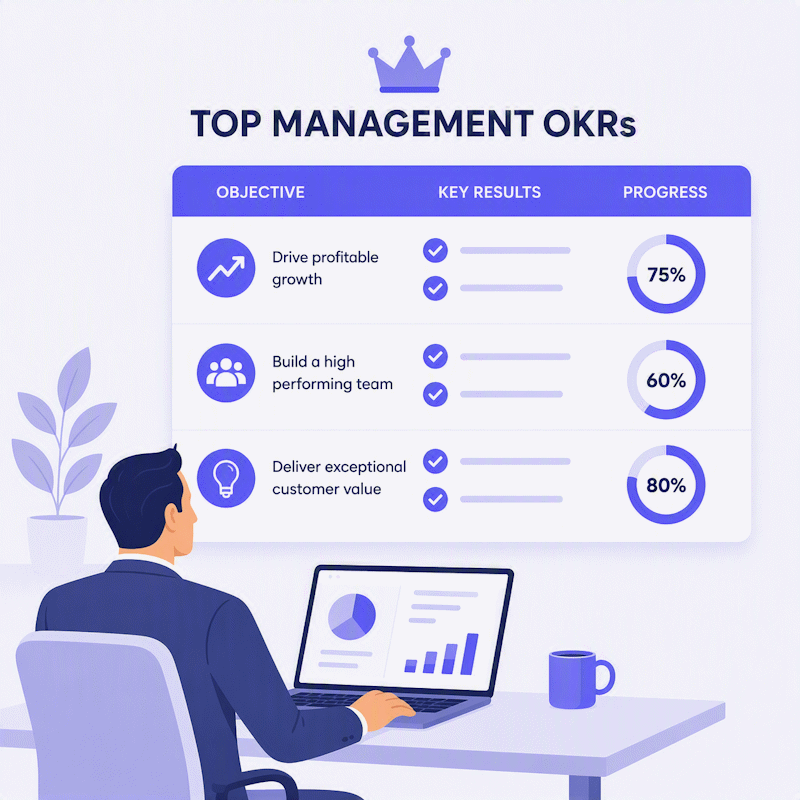
It's a common pattern in companies rolling out OKRs for the first time: leadership sets organization-level Objectives, hands them down to teams, and then steps back to watch how everyone else does. The leadership team itself never actually writes its own OKRs. This might seem efficient, but it quietly undermines the whole framework. If the people asking everyone else to commit to measurable goals aren't doing the same thing themselves, the message that sends is hard to miss.
Company OKRs Are Not the Same as Leadership OKRs
It's easy to assume that setting organization-level OKRs is the leadership team's OKR work. It isn't, at least not entirely. Company OKRs describe where the whole organization is headed. Leadership OKRs describe what the leadership team itself is specifically responsible for doing to get there, things like closing a key hire, landing a strategic partnership, or fixing a specific organizational bottleneck. This is close to how Andy Grove originally framed OKRs in High Output Management: a tool every level of an organization, including its leaders, uses to make its own commitments explicit. Without that layer, leadership's actual accountability can stay vague even while every other team in the company is tracking specific, measurable commitments.
Modeling the Behavior You Want From Everyone Else
If you want teams to take OKRs seriously, check in on them regularly, and be honest when a Key Result is off track, leadership needs to visibly do the same thing. This is not about optics for their own sake. It's a straightforward matter of credibility. When employees can see that the leadership team also sets ambitious goals, also has metrics that sometimes come in under target, and also holds itself to the same check-in rhythm, the whole OKR process feels like a shared discipline rather than a task assigned from above. When leadership skips this step, OKRs can start to feel like a management tool used on employees rather than a shared way of working, which is the same accountability gap Harvard Business Review describes when leaders ask for commitments they don't hold themselves to.
What Leadership OKRs Should Actually Look Like
Leadership OKRs should be genuinely owned by the leadership team, not just a summary of what everyone else is doing rolled up into one document. Good leadership Objectives tend to focus on things only leadership can drive: strategic direction, major hires, organizational structure, key partnerships, and removing cross-team blockers that individual teams cannot resolve on their own. If a leadership OKR could just as easily belong to one specific team, it's probably not really a leadership goal, it is that team's goal wearing a leadership label.
Handling Vulnerability at the Top
One reason leadership teams sometimes avoid setting their own visible OKRs is discomfort with being seen to fall short in front of the whole company. That discomfort is worth naming directly, because it is exactly the same discomfort everyone else in the organization feels when their own OKRs are visible. If leadership wants employees to feel safe setting ambitious goals and missing some of them without consequence, leadership has to be willing to model exactly that. A leadership Key Result landing at 60% and being discussed openly in a company update does more to build a healthy OKR culture than almost any policy statement could.
How Easy OKR Supports Leadership Accountability
In Easy OKR, leadership teams can set and track their own OKRs using the exact same simple structure everyone else in the organization uses, visible on the same dashboards. There's no separate, more complex process reserved for executives. That consistency is part of the point: the tool treats leadership OKRs as just another set of goals in the system, not a special category that lives outside the process everyone else follows.