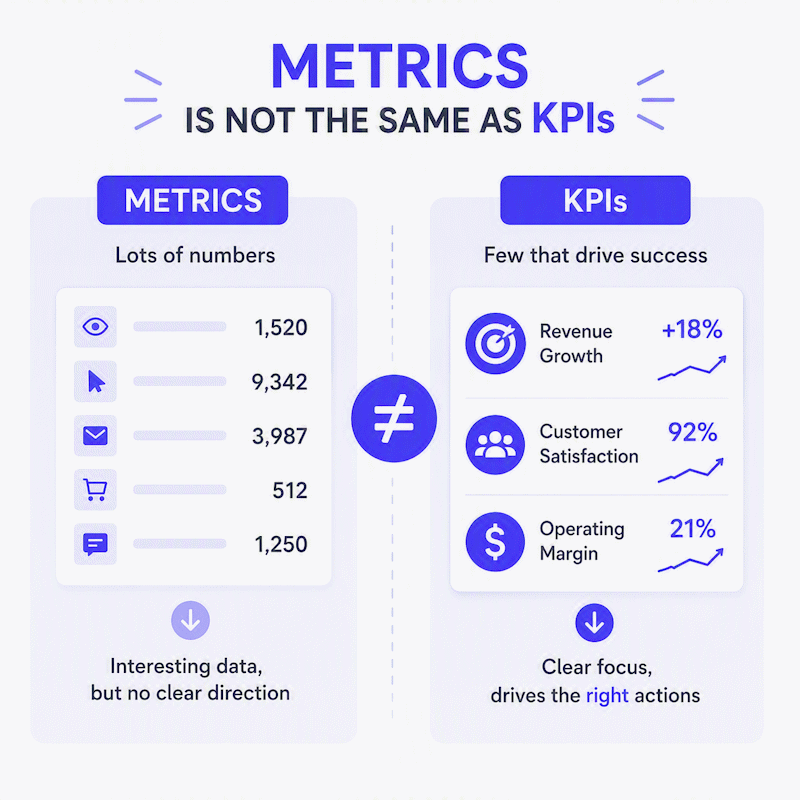
KPIs Are Not Metrics: Why the Difference Matters
"Metric" and "KPI" get used interchangeably in most workplaces, but they aren't the same thing. A metric is any number you can measure. A KPI, a Key Performance Indicator, is a specific metric tied to a strategic goal, with a target and an owner responsible for it. Treating every metric like a KPI is how dashboards end up full of numbers that look important but don't actually drive any decisions.
A Metric Is Just a Number
Almost anything can be turned into a metric. Page views, number of Slack messages sent, average email length, number of meetings held. These are all measurable. None of them are automatically meaningful. A metric only tells you that something happened; it doesn't tell you whether it mattered, and it doesn't come with any judgment about what "good" looks like.
A KPI Is a Metric With a Job
A KPI is different. It's a metric that has been deliberately chosen because it reflects progress toward something the organization actually cares about, it has a defined target, and someone is accountable for moving it. Monthly recurring revenue is a KPI for a subscription business because it's directly tied to the strategic goal of sustainable growth, has a clear target, and usually has an owner. The number of blog posts published last month is just a metric, unless it's explicitly tied to a goal like organic traffic growth with a defined target behind it.
The distinction isn't about which numbers are more impressive. Plenty of KPIs are simple numbers. What makes them a KPI is the deliberate link to strategy, not the complexity of the calculation, a point APQC's guidance on KPIs, measures, and metrics makes as well: every KPI is a measure, but not every measure earns KPI status.
Why the Confusion Causes Real Problems
When teams treat every available metric as a KPI, dashboards balloon with numbers nobody is actually accountable for. Reviews turn into a tour of interesting trivia instead of a conversation about whether the organization is on track. Worse, it becomes easy to hide behind a metric that's moving in a good direction while the thing that actually matters stays flat, simply because nobody separated the signal from the noise.
How This Connects to OKRs
OKRs make the metric versus KPI distinction unavoidable in a useful way. A Key Result isn't just any measurable number, it's meant to be the specific, targeted indicator that proves an Objective was achieved. That's essentially a KPI at the OKR level: a metric deliberately chosen, given a target, and assigned an owner for one cycle. Writing a Key Result forces you to ask the same question that separates a KPI from a plain metric: does this number, if it moves, actually prove we made progress on something that matters?
Teams that already track a handful of ongoing KPIs often use OKRs to decide which lever to pull next. The KPI shows you the ongoing health of the business; the OKR is the deliberate push this quarter to move one of those numbers, or to build the capability that will move it later.
A Simple Filter for Your Dashboard
Before calling something a KPI, ask three questions: is there a specific target attached to it, is someone actually accountable for it, and does it clearly connect to a strategic goal? If the answer to any of those is no, it's a metric worth watching, not a KPI worth managing by. This simple filter alone tends to shrink most dashboards down to a much shorter, much more useful list. Easy OKR applies the same logic to Key Results, keeping the focus on the few numbers that actually prove progress rather than every number that happens to be measurable.