
Using KPIs Alongside OKRs
KPIs (Key Performance Indicators) measure ongoing health. OKRs drive change. This article explains how to use both without confusion. Many teams struggle because they treat everything as an OKR or everything as a KPI. The key is understanding when each tool is appropriate and how they complement each other.
KPIs vs. OKRs
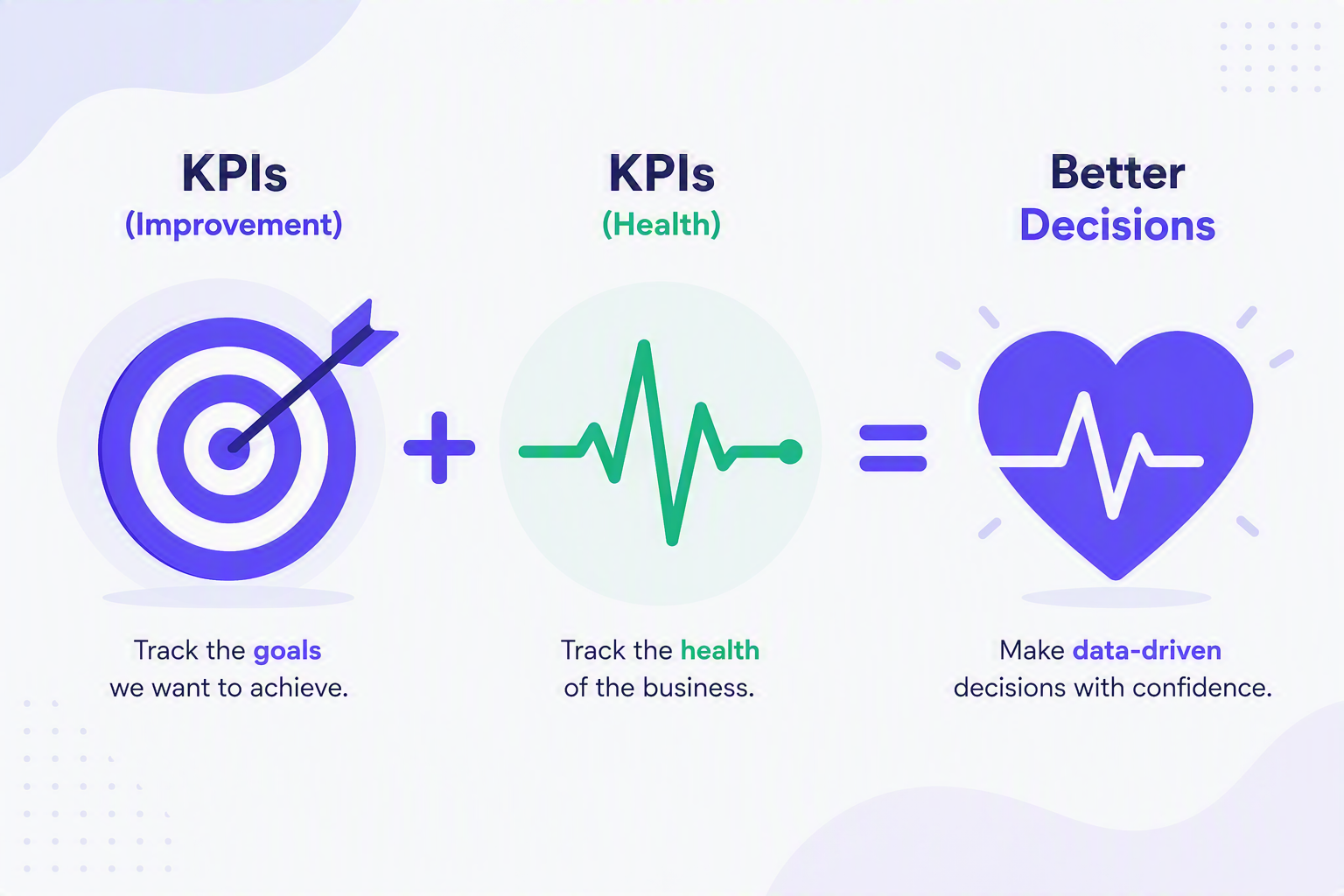
KPIs: Stable metrics you monitor continuously (e.g., uptime, revenue, churn). These represent business-as-usual performance that you track month over month and year over year. They tell you if the business is healthy and operating within acceptable ranges. Think of them as vital signs—the same kind of leading indicators executives use to track business health.
OKRs: Time-bound goals that drive improvement (e.g., reduce churn from 5% to 3% this quarter). These represent focused efforts to make meaningful change in a specific area. They're about moving the needle, not maintaining the status quo, as Google's re:Work guide to setting goals with OKRs explains.
When to use each
Use KPIs to track business-as-usual performance. These are the metrics you'd check weekly or monthly to make sure nothing is broken. Customer acquisition cost, monthly recurring revenue, and system uptime are typical KPIs—important to monitor but not targets for active improvement every quarter.
Use OKRs when you want to make a meaningful change. If customer satisfaction is fine, keep it as a KPI. If it's declining or you want to push it to best-in-class levels, make it an OKR for a quarter with specific improvement targets.
KPIs can become OKRs
If a KPI is declining or needs improvement, turn it into an OKR for a quarter. Once fixed, it goes back to being a KPI. For example, if your NPS score drops from 65 to 45, you might set an OKR to bring it back to 60. Once you hit that target, NPS returns to your KPI dashboard where you monitor it for stability. This back-and-forth is normal and healthy. It shows the team is using both tools as intended: KPIs for steady monitoring, and OKRs for focused improvement when something needs attention.
A simple example
Imagine a support team that tracks average response time as a KPI, sitting steadily around 4 hours. One quarter, a product launch causes ticket volume to spike, and response time creeps up to 9 hours. The team turns this into an OKR: "Restore fast, reliable support during peak demand," with a key result to bring response time back under 4 hours within the quarter. Once the target is hit and response time stays stable for a few weeks, it moves back to being a KPI the team simply monitors.
Don't over-track
Track 5-10 KPIs and 3-5 OKRs per team. More than that creates noise and dilutes focus. Every metric you add is one more thing competing for attention. Be ruthless about what actually matters. If a metric hasn't changed anyone's decision in the last quarter, it may not be worth tracking at all.
Common mistakes to avoid
Teams new to this approach often run into the same few pitfalls. Watch out for these:
- Turning every KPI into an OKR, which spreads effort too thin across too many goals at once
- Setting OKRs for metrics that are already healthy, wasting a quarter on something that didn't need active improvement
- Forgetting to move a metric back to KPI status once its OKR target is reached
- Tracking KPIs without ever reviewing them, so a decline goes unnoticed for months