
Strategy, KPIs, and OKRs Explained With a Simple Car Analogy
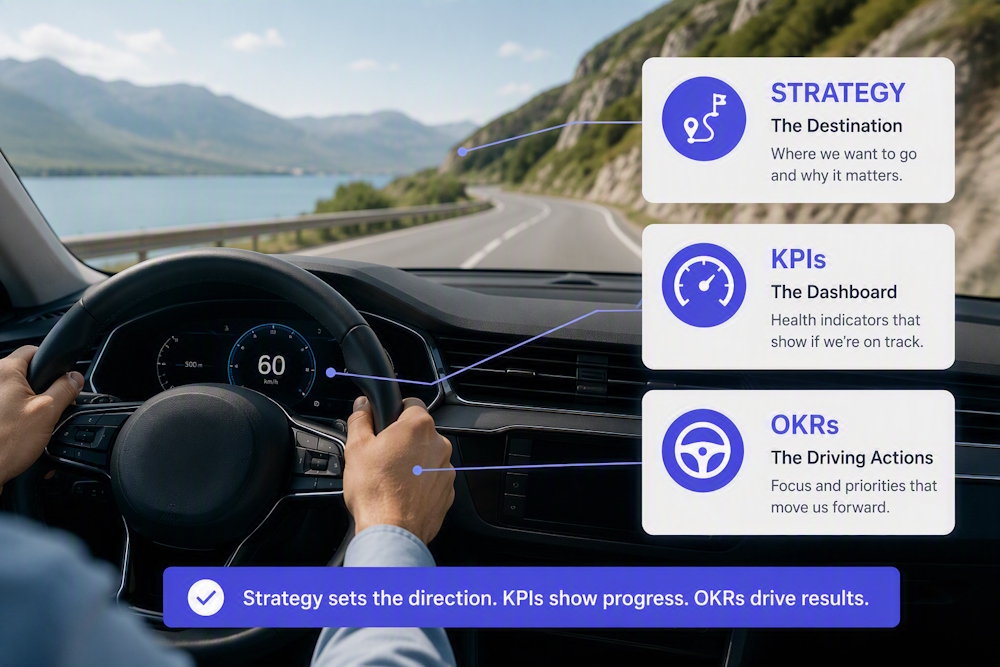
Strategy, KPIs, and OKRs get confused constantly, partly because people use them interchangeably and partly because nobody explains how they actually relate. Here's a simple way to keep them straight: think of running your organization like driving a car on a long trip.
Strategy Is the Destination and the Route
Before you start driving, you decide where you're going and roughly how you'll get there. That's your strategy. It's the high-level direction: which market you're heading toward, what kind of organization you're trying to build, which route makes sense given the terrain. Strategy doesn't change every week. You don't redraw your route every time you hit a stoplight. It's a long-term commitment that only changes when something significant happens, like discovering the bridge on your planned route is out. As Michael Porter put it in his classic Harvard Business Review essay "What Is Strategy?", strategy is about choosing a distinct position and making trade-offs, not chasing every opportunity at once.
KPIs Are the Dashboard
Once you're driving, your dashboard tells you how the car is doing right now. Speed, fuel level, engine temperature. These are your KPIs: ongoing indicators of health that you glance at constantly but don't obsess over individually. A KPI doesn't tell you where to go, it tells you whether things are currently okay. If your fuel gauge is low, that's useful information, but it doesn't tell you whether you're headed the right direction. It just tells you something needs attention. This is the same idea Robert Kaplan and David Norton described in their Harvard Business Review work on the balanced scorecard: ongoing indicators only become useful once they are tied back to strategy and action.
OKRs Are This Quarter's Driving Maneuvers
Between where you are and your final destination, there's a series of specific moves: take this exit, merge onto that highway, stop for gas at this town. These are your OKRs. They're not the destination itself, and they're not a permanent reading like the dashboard. They're the concrete, time-bound actions you're committing to right now to make progress toward the destination. "Take the next exit and merge onto Highway 40" is a clear, achievable, checkable maneuver, much like a well-written Key Result: specific, measurable, and done within a defined window.
Putting the Three Together
A road trip without a destination is just aimless driving, even with a perfect dashboard. That's a company with great KPI tracking but no strategy: lots of numbers, no direction. A destination without a dashboard is reckless. You might be driving straight toward your goal while quietly running out of gas. And a destination with a dashboard but no plan for the next few miles just means sitting at the on-ramp, watching the fuel gauge, going nowhere. That's strategy and KPIs without OKRs: good intentions and good visibility, but no concrete next move.
All three need to work together. Strategy sets the direction. KPIs tell you how the vehicle is running along the way. OKRs are the specific moves you make this quarter to actually get closer to the destination.
Where This Gets Practical
When priorities feel muddled, it's often because these three levels have gotten mixed together. A team debating a KPI target in the same conversation as a company's long-term strategy is trying to read the fuel gauge and plan the whole route at the same time. Separating the three, deciding on direction first, keeping an eye on ongoing health second, and committing to this quarter's specific moves third, tends to make each conversation clearer and shorter.
Easy OKR focuses specifically on that third layer: helping teams define and track the concrete maneuvers for the current cycle, without trying to also be a long-term strategy tool or a full business intelligence dashboard. Keeping that scope narrow is part of what keeps it simple to use.