
Finding the Right OKR Cadence: How Often to Review and Reset
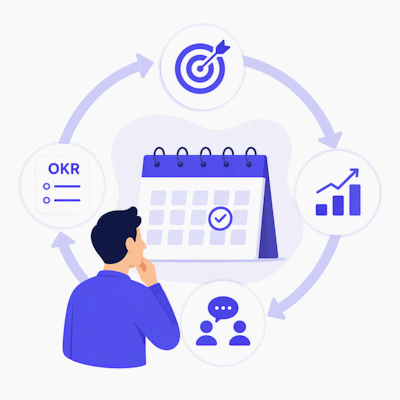
Quarterly OKRs are the default almost everyone starts with, and for many teams they work fine. But quarterly is a convention, not a rule. The right cadence depends on how fast your team's priorities actually change, how big the team is, and how much runway you need to see meaningful progress. Here is how to think about it.
Why Quarterly Became the Default
Three months is long enough to make real progress on a meaningful goal, and short enough to course-correct before too much time is wasted on the wrong thing. It also happens to line up neatly with how most businesses already think about planning and reporting. That combination is why it became the standard starting point when the OKR framework spread beyond its origins at Intel and Google, a history John Doerr traces in detail in his book Measure What Matters.
When Shorter Cycles Make Sense
Early-stage startups often move too fast for a quarterly cycle to hold up. Priorities that made sense in January can be irrelevant by March. For teams like this, a six-week or monthly OKR cycle can keep goals closer to reality. The tradeoff is less time to see a Key Result really move, so keep ambitions realistic for the shorter window.
When Longer Cycles Make Sense
Teams working on goals with naturally long feedback loops, such as a major infrastructure migration or a slow-moving market shift, can find quarterly resets create pressure to show change before it is realistic to expect any. In these cases, a two-quarter or even annual Objective, broken into quarterly Key Results, can be a better fit than forcing a full reset every three months.
Match Cadence to Team Size and Pace of Change
A ten-person startup and a five-hundred-person Organization do not need the same rhythm. Smaller, faster-moving teams generally benefit from shorter cycles because priorities shift quickly and alignment is easy to maintain informally. Larger teams often need the extra structure of a full quarter to align across departments before resetting again. There is no universal right answer, only what fits your team's actual pace of change.
Check-Ins Are a Separate Question From Cycle Length
How often you set new OKRs and how often you check in on existing ones are two different decisions. Even with a quarterly cycle, weekly or biweekly check-ins are what keep OKRs alive day to day. Weekly works well for smaller, fast-moving teams where priorities can shift quickly. Biweekly can be enough for larger or slower-moving teams where week-to-week change is less dramatic. What matters is consistency: a cadence that is skipped half the time is worse than a slightly longer one that always happens.
Start Simple, Then Adjust
If you are new to OKRs, start with a standard quarterly cycle and weekly check-ins. It is the most well-tested starting point and gives you a baseline to compare against. Once you have run a cycle or two, you will have a much better sense of whether your team needs to move faster or slower. Easy OKR is built around this quarterly-plus-weekly default because it is the easiest rhythm for teams new to the framework to learn, while still supporting shorter or longer cycles as teams find their own pace. Research from MIT Sloan Management Review on how organizations are reshaping OKR cycles reaches a similar conclusion: cadence should follow how a team actually works, not a fixed rule.
References
- From Vision to Reality: How OKRs Are Reshaping Team Goals — MIT Sloan Management Review
- Measure What Matters — John Doerr