
Continuous OKRs vs. Quarterly Cycles
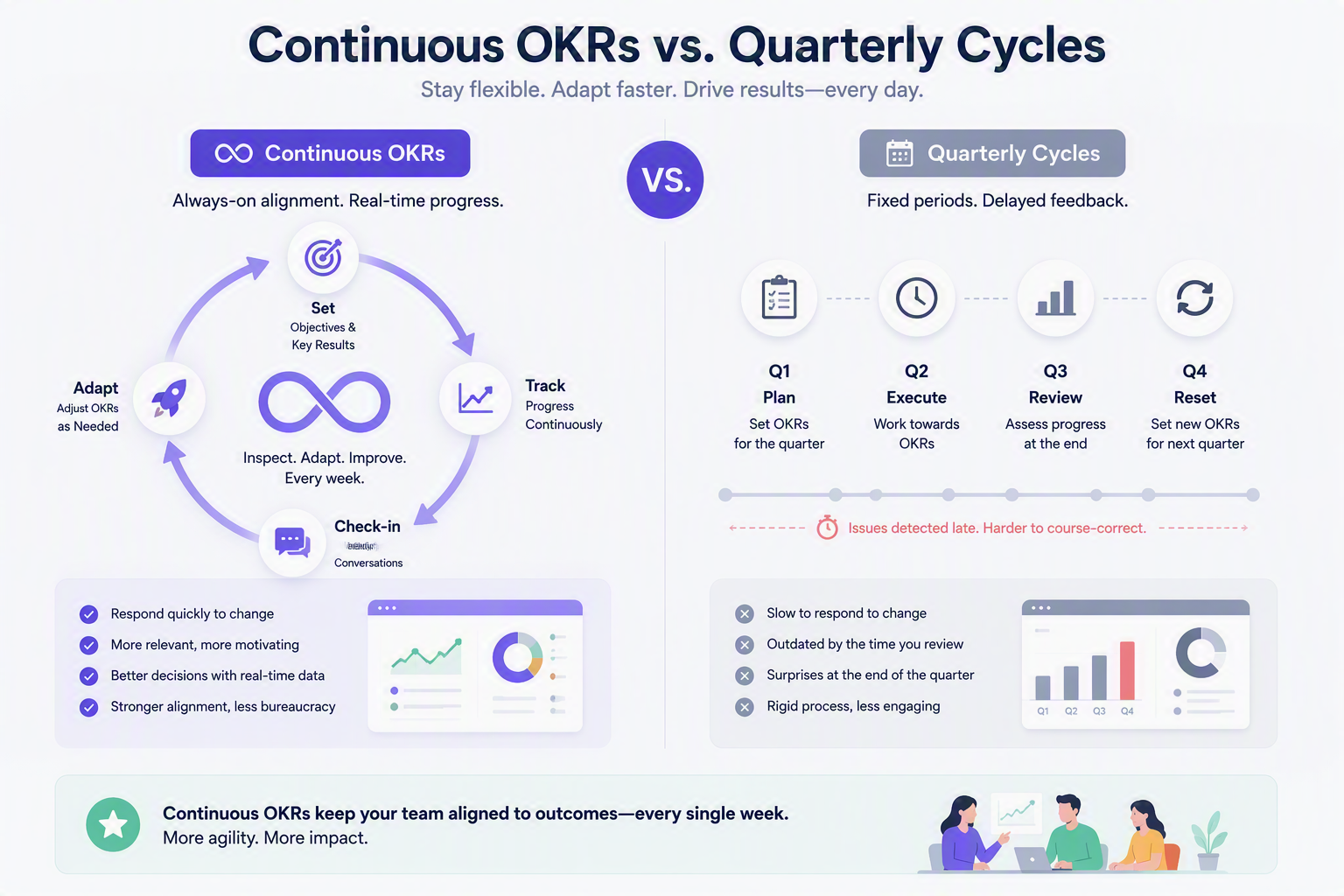
The standard advice for OKRs is to run them in quarterly cycles. Set goals at the start of the quarter, track progress throughout, and review at the end. But what if that's holding you back?
The Problem with Rigid Cycles
Quarterly cycles create artificial boundaries. Goals that naturally span six months get split across two quarters. Strategic priorities that need three weeks to test get delayed until "the next cycle." Teams wait for quarter-end to adjust course, even when they know something isn't working. Bain & Company research published in Harvard Business Review argues that "fixed-cycle is out" and dynamic, adaptive planning is what actually works in fast-changing conditions.
The rigidity makes OKRs feel like a ceremony instead of a tool. You plan in bursts, then execute in silence, then scramble to justify scores at the end. The process becomes about feeding the cycle, not driving results.
What Happens When You Force a Fixed Cycle Length
Many organizations know their quarterly cadence doesn't fit the work, but stick with it anyway because "that's how OKRs are done." In practice, forcing every objective into the same fixed window creates a predictable set of problems.
On the practical side, teams fall into a spike-and-silence pattern: a burst of activity when goals are set, near-silence for the middle weeks, then a scramble to update numbers right before the review. Ambition quietly shrinks too. When a missed target feels like a personal failure, people start setting goals they're already confident they'll hit, which defeats the purpose of an aspirational goal in the first place. Reviews turn into performance theater instead of honest problem-solving, because nobody wants to explain a red key result to a room. Work that genuinely needs six weeks gets padded to fill a full quarter, and work that needs six months gets artificially chopped into disconnected chunks at the quarter boundary, breaking the thread between cause and outcome. Deadline pressure near cycle-end also pushes teams to cut corners just to close out a key result on time, a dynamic well documented in software teams, where tight, business-driven deadlines are one of the most common reasons technical debt accumulates.
The strategic drawbacks run deeper. Fixed cycles discourage mid-cycle correction: teams often know within the first few weeks that a goal is wrong, but wait for the quarter to end anyway because changing course mid-cycle can look like instability. That delay has a real cost. Research on strategic agility points out that over-optimizing around a rigid planning rhythm creates organizational rigidity, and that delayed decision-making in response to new information results in lost opportunities. A single calendar-driven cycle also ignores that different parts of an organization move at different speeds — sales cycles, product experiments, and infrastructure work rarely share the same natural rhythm, so one fixed length is always wrong for someone. Over time, this locks teams into pursuing goals that no longer reflect what the market or the organization actually needs.
What Continuous Tracking Looks Like
Continuous OKRs flip the model. Goals have flexible timeframes — set a start and end date that fits the work, not the calendar. Some objectives take six weeks. Others span a year. What matters is the outcome, not conforming to a quarter.
Progress tracking happens continuously. Update key results weekly or bi-weekly as new data comes in. Spot problems early. Celebrate momentum as it builds. Adjust goals when circumstances change, not when the quarter ends.
Where Cycles Still Add Value
Continuous tracking doesn't mean abandoning structure. Cycles become review checkpoints—moments to step back, reflect, and decide what's next. But they're optional rhythms, not hard containers.
Use quarterly reviews to assess overall progress, run retrospectives, and set new priorities. But don't force every goal to fit that cadence. Let the work define the timeline, then use cycles to create reflection points. This mirrors what McKinsey found in its research on the future of performance management: ongoing, real-time feedback beats rigid, calendar-driven review cycles.
The Shift in Mindset
Traditional OKRs ask: "What can we achieve this quarter?" Continuous OKRs ask: "What outcome are we trying to drive, and when should we expect to see it?"
The first question optimizes for planning. The second optimizes for impact. When you stop forcing goals into quarters, you start designing goals around the actual pace of your business.
Making the Change
Start by setting objectives with their own timeframes. If a goal needs eight weeks, give it eight weeks. If it takes six months, plan for that. Track progress continuously with lightweight check-ins. Use cycles as reflection points, not deadlines.
Easy OKR supports this model. Define flexible timelines for your objectives. Monitor progress in real-time with "What Needs Attention?" alerts. Review when it makes sense—not just when the calendar says so.
The Result
Less ceremony. More focus. Faster adaptation. Teams stop gaming the system and start optimizing for outcomes. That's what continuous OKRs unlock.
References
- Strategy-Making in Turbulent Times — Bain & Company / Harvard Business Review
- Ahead of the Curve: The Future of Performance Management — McKinsey & Company
- Architecting the Future: Why Leaders Must Balance Strategic Agility and Consistency — Harvard Business Publishing
- What's Behind Tight Deadlines? Business Causes of Technical Debt — arXiv