
Annual Planning with Quarterly OKRs
Most companies plan annually but execute in cycles. This article explains how to connect long-term vision with regular OKR review cycles. The challenge is balancing the need for long-term direction with the reality that markets change, priorities shift, and you learn new information over time. The solution is annual themes with time-boxed OKRs that adapt as you go. This gap between planning and doing is well documented: Harvard Business Review research found that companies typically realize only about 60% of their strategy's potential value because of breakdowns between planning and execution.
Start with annual themes
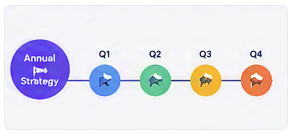
Define 3-5 strategic themes for the year. These are high-level priorities that guide periodic planning. Themes are intentionally broad—they set direction without locking you into specific tactics. This gives teams the flexibility to adjust execution based on what they learn each quarter.
Examples:
- Expand into enterprise market
- Build world-class mobile experience
- Achieve operational excellence
Break themes into quarterly OKRs
For each theme, define quarterly OKRs that make progress toward the annual goal, the same cascading structure Google's re:Work guide describes for connecting organization-level annual goals to quarterly team OKRs. Each cycle should build on the previous. For example, if your annual theme is "Expand into enterprise market," Q1 might focus on understanding enterprise needs through customer research, Q2 on building required features, Q3 on piloting with early customers, and Q4 on scaling the go-to-market motion.
Review and adjust
At the end of each cycle, review progress on annual themes and adjust the next period's OKRs based on what you learned. Maybe your enterprise pilot revealed that enterprises actually need different features than you thought. Adjust Q3 accordingly. The themes stay stable, but the OKRs evolve based on reality.
Don't over-plan
Don't try to plan all four quarters in detail at the start of the year. Plan Q1 in detail, sketch Q2, and leave Q3-Q4 flexible. The further out you plan, the more likely you are to be wrong. Planning too far ahead wastes time and creates false confidence. Instead, use quarterly retrospectives to inform the next quarter's plan.
Keep themes visible
Make sure annual themes are visible throughout the year. Reference them in all-hands meetings, regular planning sessions, and team check-ins. This keeps everyone aligned on what matters most even as the specific OKRs change quarter to quarter.
Connect the levels together
Annual themes only work if every level of the organization can see how its OKRs connect back to them. When a team sets a quarterly OKR, they should be able to point to the theme it supports. If they can't, the OKR probably isn't worth doing this quarter. This simple check keeps teams from drifting toward busy work that feels productive but doesn't move the organization forward.
Avoid these common mistakes
- Treating themes as fixed targets. Themes describe direction, not a number to hit. Turning them into rigid annual targets removes the flexibility that makes this approach work.
- Resetting everything each quarter. If quarterly OKRs have no connection to the previous cycle, you lose momentum. Each cycle should build on what came before.
- Skipping the review step. Without a regular review, annual themes become a document nobody reads again until next year.
Annual planning with quarterly OKRs gives you the best of both worlds: a clear long-term direction and the flexibility to adapt as circumstances change. Set the themes once, then let quarterly OKRs carry them forward one cycle at a time.