
Why OKR Programs Die (and How to Keep Yours Alive)
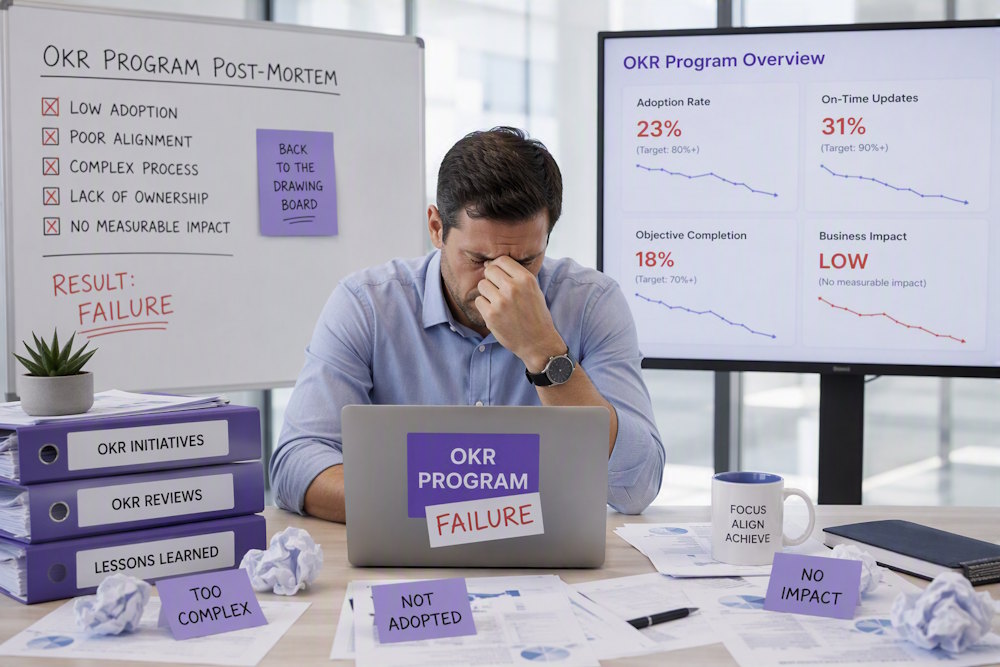
OKR programs rarely end with a formal decision to stop. Instead, check-ins get skipped one week, then another. The quarterly review gets pushed back and never rescheduled. Six months later, someone asks "didn't we used to do OKRs?" If you want to avoid that fate, it helps to know the specific ways programs tend to die.
Too Much Administrative Overhead
The single most common cause is that updating OKRs takes more effort than it's worth. If keeping a Key Result current takes real time and mental energy every week, people quietly deprioritize it in favor of work that feels more urgent. This is rarely a motivation problem. It's a design problem, either in the process or in the tool being used to track it. Our post on 5 ways to cut OKR admin overhead covers concrete fixes.
No Leadership Follow-Through
If leadership sets ambitious OKRs at the kickoff meeting and then never mentions them again until the quarter ends, teams learn quickly that OKRs aren't actually a priority, whatever was said at the start. Employees are good at reading what leadership actually pays attention to, regardless of what's officially stated. This mirrors classic research on why organizational change efforts fail: initiatives without visible, sustained leadership involvement tend to lose momentum no matter how well they started. If leaders don't reference OKRs in regular meetings or make decisions visibly informed by them, the program loses credibility fast.
OKRs Disconnected From Real Work
When OKRs feel like a parallel exercise that doesn't reflect what a team is actually spending its time on, people stop taking them seriously. This often happens when OKRs are written once at the start of the quarter and then ignored while the team responds to whatever comes up day to day. Keeping OKRs realistic and revisiting them as circumstances change, rather than treating them as fixed and disconnected from reality, keeps this from happening.
Tool Fatigue
A surprising number of OKR programs die simply because the tool became annoying to use. Clunky interfaces, too many required fields, slow load times, or a tool that duplicates work already being tracked somewhere else all push people toward the path of least resistance, which is ignoring the OKR tool entirely. This is one of the biggest reasons organizations that adopted a heavy enterprise platform, or that lost a tool entirely after a product was discontinued, end up abandoning OKRs rather than finding a lighter replacement.
No Clear Owner for the Program
OKRs need someone keeping a light hand on the process, even if it's informal. Without anyone making sure cycles start and end on schedule, that check-ins are actually happening, and that retrospectives lead to real adjustments, the program tends to drift. This doesn't require a dedicated full-time role at a small organization, just someone willing to own the rhythm.
How to Keep the Program Alive
Most of the fixes are the inverse of the causes above. Keep the process light enough that updating OKRs takes minutes, not hours. Have leadership reference OKRs in regular meetings, not just at quarter boundaries. Let OKRs adapt when circumstances genuinely change instead of treating the original plan as untouchable. Use a tool that people actually want to open, rather than one they tolerate. And make sure someone, even informally, is keeping an eye on the overall rhythm.
None of this requires a large investment. It requires treating OKRs as a habit to protect, the same way you'd protect any other practice that only works if it's kept up consistently.