
From 10% to 10x: Why Bold Targets Win
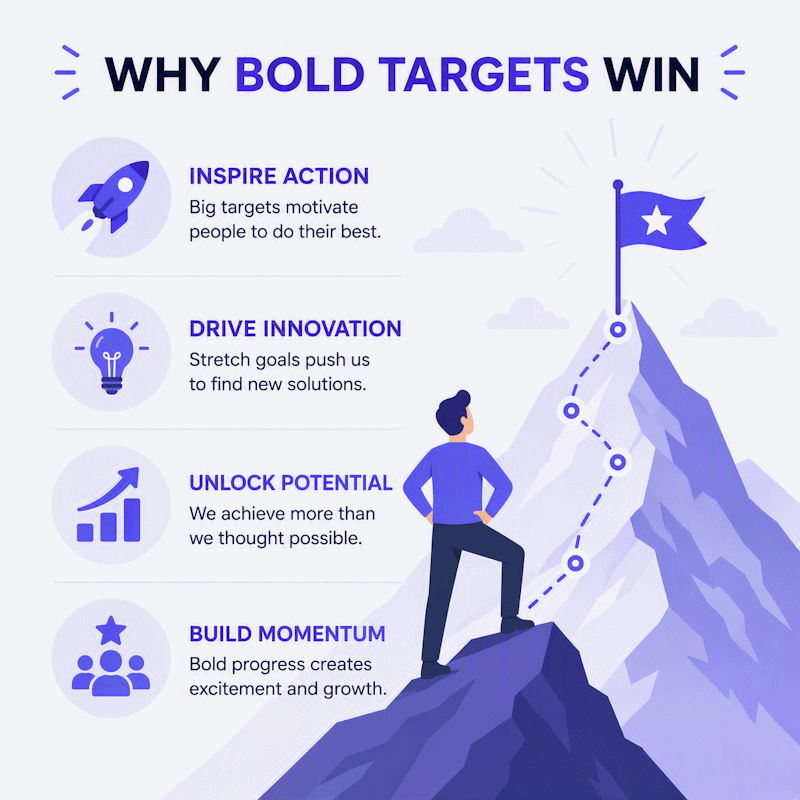
Ask a team to improve something by 10% and they will optimize what already exists. Ask the same team to improve it by 10x and they have to throw out the existing approach and start over. That difference in thinking is the entire argument for setting bold, aspirational targets instead of safe, incremental ones.
Incremental Targets Reinforce the Status Quo
A 10% improvement target almost always gets solved with more effort applied to the current process. Sell 10% more by making more calls. Cut costs 10% by trimming a few line items. These targets are useful for operational tuning, but they rarely produce new thinking. The team already knows how to hit them, so they simply do more of what they were already doing.
That's fine for stable, mature parts of the business. It's a poor fit for anything you actually want to transform.
10x Targets Force a Different Question
When the target is 10x, more effort on the current process cannot get you there. No amount of extra hustle turns 10% growth into 1000% growth. The team is forced to ask a completely different question: what would we have to do differently to even have a shot at this? That question opens the door to new ideas, new channels, and new ways of working that incremental thinking never surfaces.
This is the core idea behind aspirational OKRs, a concept popularized alongside the framework itself. Google's own guide to setting goals with OKRs distinguishes between committed goals, which you are expected to fully achieve, and aspirational goals, which are meant to stretch your thinking even if you only get partway there.
Bold Targets Change the Room, Not Just the Number
The real value of a moonshot target isn't the number itself. It's what happens in the room when people take it seriously. Ideas that would normally get dismissed as too risky suddenly become worth discussing, because the safe option clearly won't work anyway. Teams stop defending the current approach and start questioning it. That shift in mindset is often more valuable than whatever number ends up on the scoreboard at the end of the quarter.
Not Every Goal Should Be a 10x Goal
This isn't an argument for making every Key Result a moonshot. Most of your work, keeping the lights on, maintaining quality, hitting operational KPIs, should stay grounded in realistic, committed targets. Bold targets work best when applied selectively, to the one or two Objectives where you genuinely want to provoke new thinking rather than just squeeze out more of the same. Research on the stretch goal paradox backs this up: organizations that reach for extreme targets out of desperation, rather than from a position of stability, tend to see them backfire.
Mixing committed and aspirational OKRs in the same list without labeling them is a common mistake. If a team doesn't know which targets are meant to be fully hit and which are meant to stretch them, a missed aspirational target starts feeling like failure instead of what it actually is: a signal that ambitious thinking happened. This is one reason Easy OKR keeps the distinction visible and simple, so teams can set an ambitious target without the anxiety of treating it like a hard commitment.
How to Introduce a Bold Target Without Losing the Team
Be explicit that the target is aspirational, not a demand. Explain the reasoning: you want new ideas, not just more effort. And separate scoring for aspirational Key Results from committed ones, so partial progress toward a 10x goal is treated as a real win rather than a shortfall. Teams that understand the rules of the game engage with bold targets far more openly than teams who fear being penalized for missing an intentionally unreachable number.