
Beyond Annual Reviews: Continuous Performance Management With OKRs
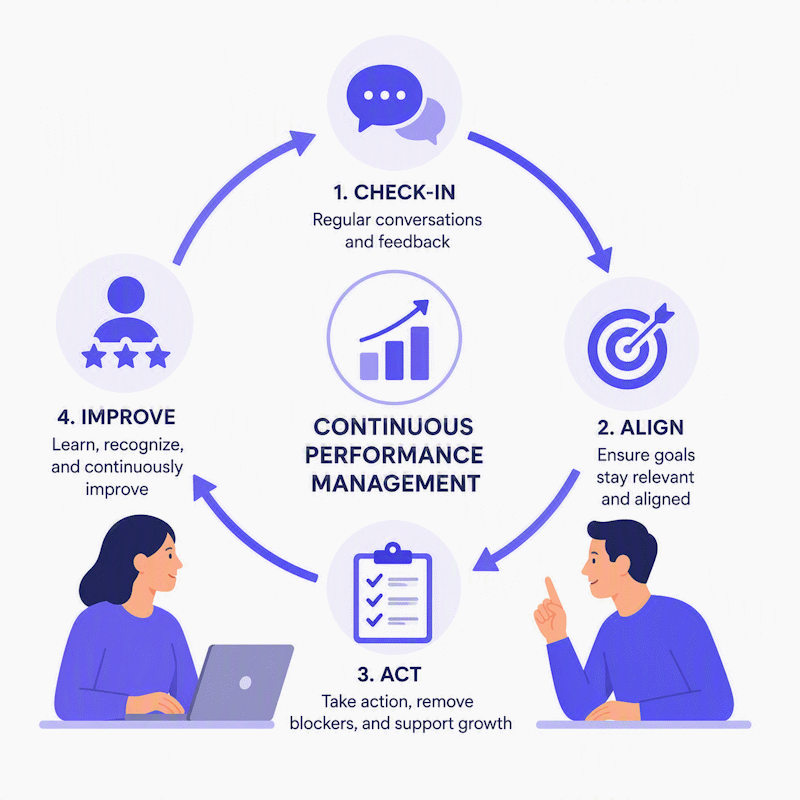
The traditional annual performance review has a timing problem. Feedback about something that happened in March arrives, if it arrives at all, in a review meeting the following January. By then the moment to actually change course is long gone. Employees are left trying to remember what they even did nine months ago, and managers are left trying to summarize a year of work into a single form. Neither side gets much value out of it. OKRs offer a different rhythm: short cycles, frequent check-ins, and feedback that arrives close enough to the work to actually matter.
Why Annual Reviews Fall Short
Annual reviews were designed for a slower world, where business priorities did not shift much within a year. That is rarely true anymore. Priorities change, projects get reprioritized, and teams pivot. A once-a-year conversation cannot keep up with that pace, and it tends to collapse a year of nuance into a single rating or summary. Worse, because so much rides on that one conversation, it often becomes stressful and political rather than useful. People spend more energy managing how they are perceived in the moment than actually improving their work throughout the year. Gallup's research on performance reviews has found they often do more harm than good precisely for this reason.
What Continuous Feedback Looks Like With OKRs
OKRs naturally create a lighter, more frequent alternative. Instead of one big review, teams run short check-ins, often weekly or biweekly, where they look at progress on their Key Results. These check-ins are quick by design: what moved forward, what is stuck, what needs to change. Because they happen so often, there is no need to save up a year's worth of context. Feedback happens close to the work, while it can still shape what someone does next. Over a full quarter, that adds up to a much richer, more accurate picture of someone's performance than a single year-end conversation ever could, a shift Harvard Business Review has documented at companies that moved away from annual ratings toward ongoing check-ins.
Separate Progress Tracking From Performance Judgment
A common mistake is to treat every OKR check-in like a mini performance review. That quickly kills the openness that makes check-ins useful in the first place. The check-in's job is to track progress on the goal, not to judge the person. Whether an individual's compensation or promotion should be tied to OKR outcomes is a separate, much bigger decision, and many organizations deliberately keep the two apart, especially early on. Keeping OKR check-ins focused on "what's happening and what do we need" rather than "how are you doing" makes them faster and more honest.
Quarterly Retrospectives Fill the Bigger-Picture Gap
Weekly check-ins are great for staying on track day to day, but they are too granular for reflecting on bigger patterns. That is where a quarterly OKR retrospective comes in. At the end of each cycle, teams step back and ask what worked, what did not, and what they learned about setting better goals next time. This gives you a natural, built-in rhythm for the kind of reflective conversation an annual review was trying to have, except it happens four times a year instead of once, with much fresher memories to draw on.
This Does Not Mean Reviews Disappear Entirely
Continuous performance management does not mean abandoning structured conversations about career growth, compensation, or development altogether. Those conversations still matter and still need dedicated time. What changes is that they are no longer the only moment feedback happens. When OKR check-ins are already surfacing progress and blockers throughout the year, a review conversation becomes a summary of things both people already know, rather than a surprise. That alone removes a huge amount of the anxiety that annual reviews tend to create.
How Easy OKR Supports This Rhythm
Easy OKR is built around lightweight, recurring check-ins rather than heavy annual processes. Because updating progress takes just a couple of minutes, teams actually keep doing it, which is the real bottleneck for most continuous performance management efforts. The goal is not to add another process on top of what HR already runs, but to give teams a simple habit that keeps feedback timely all year round.