
The Transparency Paradox: When to Open Up Your Goals
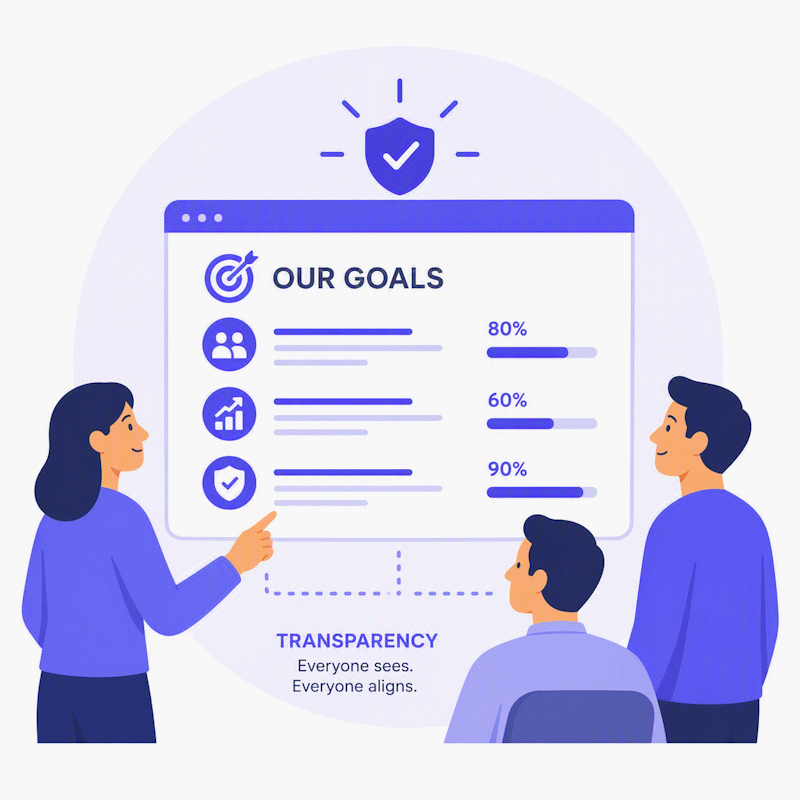
One of the defining ideas behind OKRs is that goals should be visible. Not just to the person who set them, but to the whole organization. Everyone can see what everyone else is working toward, and how it ties back to the bigger picture. This sounds great in theory. In practice, it creates a real tension. Full transparency builds trust and alignment, but it can also make people anxious, defensive, or tempted to game the numbers. Understanding that tradeoff is the key to using transparency well instead of letting it backfire.
Why Transparency Works
When goals are visible across the organization, a few good things happen naturally. People can see how their work connects to what other teams are doing, which reduces duplicated effort and makes cross-team collaboration easier. Leaders can spot gaps or misalignment early instead of finding out at the end of the quarter. And employees get a clearer sense of purpose, because they can trace a line from their own Key Results up to the Organization's Objectives. This is part of the original intent behind Objectives and Key Results, as Andy Grove described it at Intel in his book High Output Management: goals that are open by default, not hidden in a manager's private notes.
Where It Breaks Down
The problems start when transparency turns into pressure. If every Key Result is visible to the entire company, and progress is checked in publicly every week, people can start optimizing for how their numbers look rather than what actually matters. Ambitious targets, which are supposed to be a good thing in OKRs, suddenly feel risky to set because missing them is visible to everyone. Some employees respond by quietly lowering their ambition so they always look like they hit the mark. Others feel exposed when a struggling metric becomes a topic of hallway conversation. None of this is really about OKRs failing. It is about transparency being applied without enough thought for how people actually experience being watched.
Separate Visibility From Judgment
The fix is not to hide goals again. It is to be clear, as a leader, that visibility of a goal is not the same as judgment of the person behind it. A Key Result sitting at 40% completion halfway through the quarter is not automatically a problem. It might be exactly on pace, or it might reflect a genuinely hard, ambitious target that was never expected to be easy. If leaders react to a low number with concern or blame, people will quickly learn to protect themselves by setting safer goals or quietly adjusting numbers before anyone notices. If leaders instead treat an off-track Key Result as useful information, a chance to ask what help is needed, the same transparency becomes a tool for support rather than a source of anxiety. This is close to what researchers mean by psychological safety: people need to trust that surfacing a problem won't be held against them before open goals actually build trust instead of eroding it.
What Should Be Open, and What Can Stay Private
Not every goal needs the same level of visibility. Organization-level and team-level OKRs generally benefit from being fully open. That is where alignment matters most, and where hiding progress does the most damage. Individual OKRs, if you use them at all, can reasonably have a bit more privacy, especially early in a company's OKR journey when trust in the process is still being built. Some organizations choose to keep individual progress visible only to a person's manager and immediate team, while keeping team and company OKRs open to everyone. There is no single right answer here. The goal is to match the level of openness to how much psychological safety exists in the organization right now, and to widen it gradually as trust grows.
Watch for Gaming Behavior
A second risk of full transparency is that people start writing Key Results they know they can hit, rather than ones that reflect real ambition. This is a natural response to being watched. The best defense is a cultural one: consistently reinforce, in words and in how you react to results, that a Key Result landing at 70% is a normal and even expected outcome for an ambitious goal. If missing a target never actually costs someone anything real, in reviews or in how they are treated, the incentive to sandbag disappears. This is one reason many teams keep OKRs separate from performance reviews and compensation decisions entirely.
How Easy OKR Supports This
Easy OKR is built around simple, visible dashboards by design, because that visibility is genuinely useful when it is paired with the right culture. At the same time, it keeps the structure light enough that teams new to OKRs can start with team and organization-level goals fully open, without immediately forcing individual transparency before anyone is ready for it. The tool supports the transparency, but the tone leaders set around it is what determines whether that transparency builds trust or creates anxiety.