
The ROI of OKRs: Building the Business Case
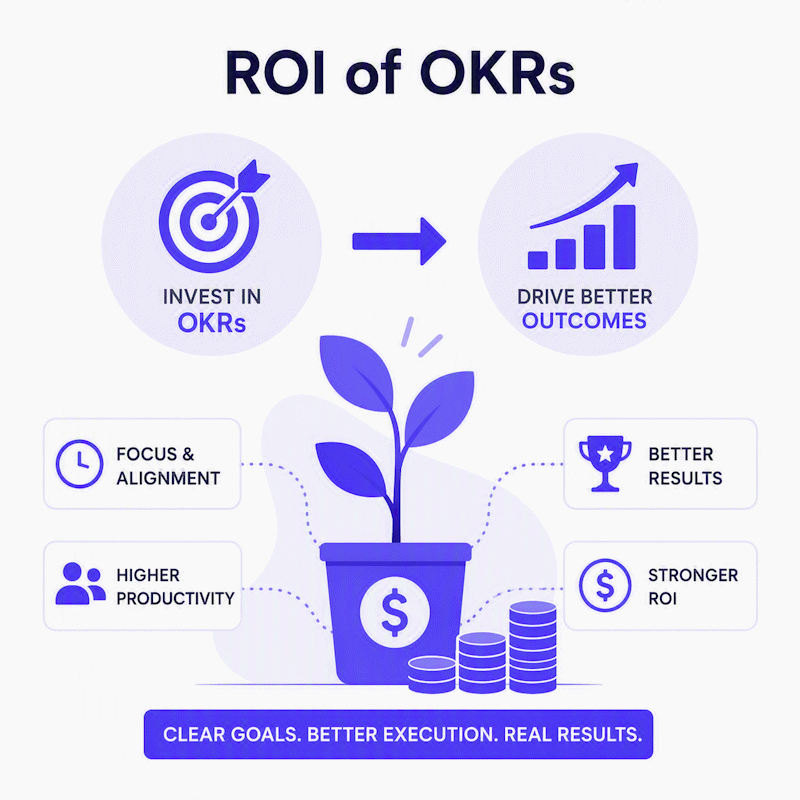
If you go looking for a definitive number on the ROI of OKRs, you'll find plenty of vendors happy to give you one. Be skeptical of all of them. There's no controlled experiment that isolates "adopted OKRs" from every other variable in a business and produces a clean return figure, and any tool claiming otherwise is likely working backward from a number they wanted to publish. That doesn't mean there's no business case to make. It just means the case has to be built on reasoning, not a fabricated statistic.
Why a Precise ROI Number Doesn't Exist
OKRs aren't a standalone intervention like a marketing campaign with a clear cost and a trackable conversion. They're a management practice that touches how decisions get made, how priorities get communicated, and how progress gets tracked, across an entire organization, at the same time as everything else that's happening in the business. Isolating the specific financial contribution of "we started using OKRs" from market conditions, other initiatives, and normal variance is not something any organization can honestly do with precision. Treat any specific percentage claim you see with real skepticism.
Build the Case on Mechanism, Not a Made-Up Multiplier
A more credible business case focuses on the specific mechanisms through which clearer goals plausibly reduce cost and waste, and lets leadership judge the value themselves. A few worth naming directly:
- Less wasted effort. Teams without clear priorities tend to spread effort across too many initiatives at once. A small number of clearly defined Objectives concentrates effort where it matters most, which reduces work that ends up thrown away or deprioritized halfway through.
- Faster course correction. A team that checks progress against a Key Result every week or two notices when something is off track much sooner than a team that reviews goals once a year. Catching a problem in week three instead of month three is a meaningful difference in cost, even without a precise multiplier attached to it. This is close to the argument MIT Sloan Management Review makes for frequent, lightweight goal cycles over slower annual planning.
- Fewer meetings spent debating priorities. When Objectives are written down and visible, less time gets spent re-litigating what matters most in every planning conversation.
- Better alignment across teams. When teams can see how their Objectives connect to each other, duplicated effort and conflicting priorities become easier to spot before they cause real damage. Harvard Business Review's research on OKR adoption points to this kind of cross-team visibility as one of the clearest, most defensible benefits.
Frame It as Risk Reduction, Not Just Upside
Executives often respond better to a risk-reduction argument than a growth argument. Ask what it currently costs the organization when priorities are unclear: initiatives that quietly stall, effort spent on work that turns out not to matter, surprises discovered too late to fix cheaply. OKRs, run well, are a structure for catching that kind of drift early. That's a genuine, defensible case, even without a specific dollar figure attached to it.
Keep the Cost Side Honest Too
A credible business case also accounts for cost, not just benefit. The real cost of OKRs isn't the price of a tool, it's the time spent setting goals and checking in on them. This is exactly where tool choice matters. A heavy, complex platform adds real administrative overhead that eats into the case you're trying to make. A lightweight tool minimizes that cost, which is part of the argument for starting with something simple like Easy OKR rather than a large enterprise platform: the lower the ongoing cost of running OKRs, the easier the business case is to defend.
Let a Pilot Make the Case for You
The strongest business case is rarely a projection, it's a result. Running a focused pilot with one or two teams for a single quarter, then reviewing honestly what changed, gives you real evidence instead of a theoretical argument. If the pilot team reports clearer priorities and catches problems earlier, that's a business case leadership can trust, because they watched it happen instead of being asked to take a number on faith.