
8 Signs You've Outgrown Spreadsheets for OKR Tracking
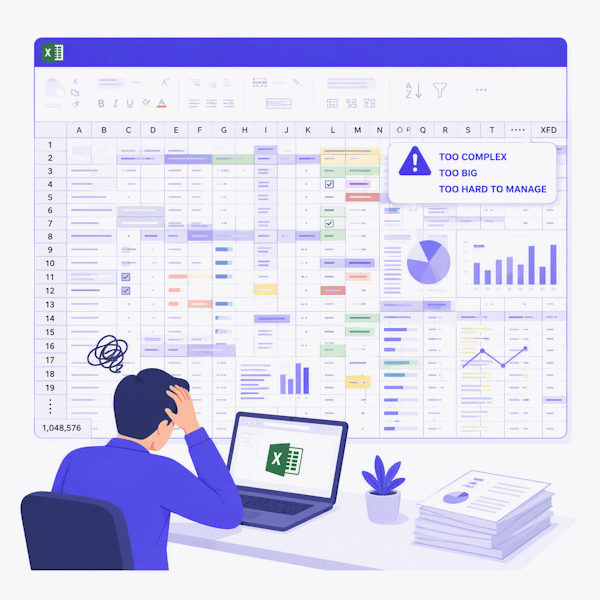
A shared spreadsheet is a perfectly reasonable way to track OKRs when a startup is small. It's free, everyone already knows how to use it, and it takes ten minutes to set up. The trouble is, spreadsheets don't scale gracefully. They tend to work fine right up until they suddenly don't, and by then a lot of goal-tracking discipline has quietly broken down. Here are eight signs your organization has outgrown the spreadsheet, and it's time for something purpose-built.
1. Nobody Can Agree Which Tab Is Current
As OKR cycles roll over, spreadsheets tend to accumulate tabs: Q1, Q1 v2, Q1 FINAL, Q2 draft. Eventually someone updates the wrong tab, or two people are looking at different versions in a meeting without realizing it. A dedicated tool has exactly one current state, so this confusion simply can't happen.
2. Updating Progress Requires Finding the Right Cell
In a growing spreadsheet, updating your own Key Result means scrolling through rows that belong to other teams, hunting for the right cell, and hoping you don't accidentally overwrite a formula. That friction adds up. When updating takes more than a minute of effort, people quietly stop doing it, and the whole point of regular check-ins falls apart.
3. There's No History of How a Number Got There
A spreadsheet cell shows you the current number, not how it got there. If a Key Result jumps from 40% to 70% between two check-ins, there's no record of what happened in between, no comment, no context, nothing to look back on during a retrospective. That history is often more useful than the final number itself.
4. Alignment Between Teams Is Just a Guess
In a spreadsheet, showing how a team's Key Result ladders up to a company Objective usually means a manually maintained column, or worse, just tribal knowledge. As more teams and more OKRs get added, keeping that alignment accurate by hand becomes unrealistic, and most organizations quietly give up trying.
5. Permissions Are All or Nothing
Spreadsheets generally offer edit access or view-only access, with not much in between. As a company grows past a handful of people, that becomes a real problem. Either everyone can edit everything, which invites accidental changes, or access gets so locked down that people can't see goals outside their own team, which quietly undermines the transparency OKRs are supposed to provide.
6. Reporting to Leadership Means Manual Copy-Pasting
Someone, often a founder or an ops lead, ends up spending an hour before every leadership meeting manually pulling numbers out of team spreadsheets into a summary deck. That's real time spent on formatting instead of on the actual work, and it's exactly the kind of task a dedicated OKR tool eliminates automatically with a live dashboard.
7. Broken Links and Formulas Are a Regular Occurrence
Once a spreadsheet gets complex enough to have cross-references and formulas linking different tabs together, it also becomes fragile enough that one careless edit can break a formula for everyone. Fixing it takes time from whoever built the original formula, and if that person leaves the organization, nobody may know how to fix it at all. This isn't just anecdotal: research on spreadsheet errors from the University of Hawaii found that errors turn up in a meaningful share of cells in most real-world spreadsheets, and that people are only moderately good at catching them.
8. New Hires Need a Tutorial Just to Find Their Goals
When onboarding a new employee involves a five-minute explanation of "here's the spreadsheet, this is your tab, don't touch the other ones," that's a sign the system has outgrown its format. A purpose-built tool should be obvious enough that a new hire can find their own OKRs and understand how they connect to the team's goals without a guided tour.
Why This Matters More as You Grow
None of these problems are really about spreadsheets being bad tools. Spreadsheets are great at what they're built for. They're just not built for structured, cross-team, recurring goal tracking, and that gap tends to show up right around the time a startup moves from a single team to several, which is exactly the transition MIT Sloan Management Review examines in its research on why scaling companies stumble. This is exactly the gap Easy OKR is built to fill: a lightweight, dedicated OKR tool that keeps the simplicity of a spreadsheet, one shared view, quick updates, without the fragility that comes with stretching a spreadsheet past what it was designed for.