
SMART Goals Are Overrated. Here's Why.
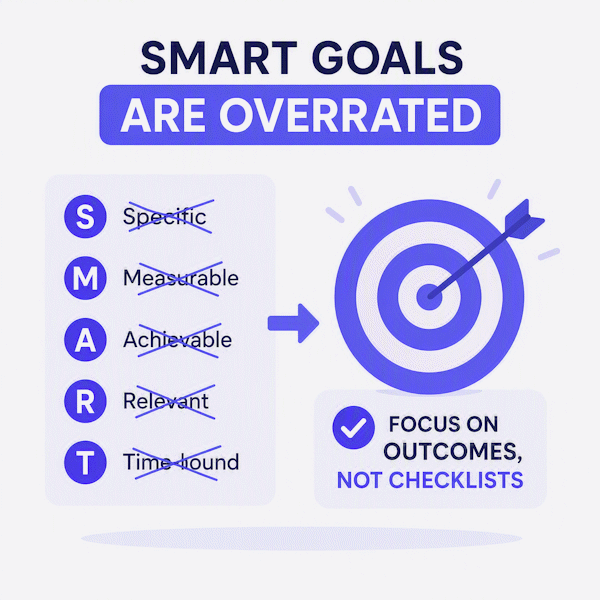
SMART goals, Specific, Measurable, Achievable, Relevant, Time-bound, have been the default goal-setting framework taught in business schools and management trainings for decades. It's a genuinely useful checklist. But it has a quiet flaw that becomes obvious once a team tries to use it to drive real ambition: the "Achievable" part pulls directly against the kind of stretch goals that actually move a business forward. A goal that is comfortably achievable is, almost by definition, not asking much of anyone.
The Trouble With "Achievable"
When people are told their goal needs to be achievable, the natural response is to aim for something they are confident they can hit. That is a sensible instinct for an individual protecting their own track record, but it is a bad instinct for an organization trying to grow quickly. Ambitious targets, the kind that force new thinking or genuinely different approaches, are almost never comfortably achievable at the time they're set. SMART's built-in requirement for achievability quietly filters those goals out before they're even written down.
SMART Doesn't Separate the "What" From the "How Much"
Another limitation is structural. A SMART goal is usually a single sentence that tries to be specific, measurable, and time-bound all at once, like "Increase monthly active users by 15% by the end of Q2." That single sentence has to carry both the qualitative intent (grow the user base) and the specific numeric target (15% by Q2) at the same time. OKRs split these two jobs apart deliberately. The Objective carries the qualitative, inspiring intent, "Make our product the default choice for new users." The Key Results carry the specific, measurable targets underneath it. This split makes it much easier to set an ambitious, motivating Objective without getting tangled up in exactly which number defines success, which can be worked out separately in the Key Results.
Measurable Is Still the Right Idea
To be fair to SMART, the "Measurable" principle is exactly right, and it's one OKRs fully inherit. A goal that can't be measured can't really be tracked, and vague goals like "improve customer satisfaction" without a number attached tend to quietly fade away over a quarter. Good Key Results are just as specific and measurable as a good SMART goal would be. The difference is that OKRs don't ask that same Key Result to also be comfortably achievable. It's fine, even expected, for a Key Result to be a genuine stretch.
What Locke and Latham's Research Actually Supports
The foundational research on goal setting, from psychologists Edwin Locke and Gary Latham, actually supports harder goals over easier ones, within reason. Their book A Theory of Goal Setting and Task Performance found that specific, challenging goals tend to produce higher performance than vague or easy ones, as long as the person pursuing the goal has the ability and commitment to pursue it seriously. That is closer to how OKRs are meant to work than how SMART goals are typically applied in practice, where "Achievable" often gets interpreted as "safe." It is worth adding a caveat researchers have raised since: a Harvard Business School working paper on the side effects of over-prescribing goal setting found that narrow, single-minded pursuit of a hard number can also backfire, which is exactly why OKRs pair an ambitious Objective with a small set of specific Key Results rather than one number alone.
When SMART Still Makes Sense
None of this means SMART goals are useless. For well-understood, operational work, hitting a known compliance deadline, finishing a scoped project, SMART's emphasis on being specific and time-bound is genuinely helpful, and achievability is a reasonable expectation. The mismatch shows up specifically when SMART is used for ambitious, forward-looking goals, the kind meant to push an organization somewhere new. MIT Sloan Management Review makes a similar case for faster, more ambitious goal cycles over SMART's caution. That's exactly the territory OKRs were designed for.
How Easy OKR Reflects This
Easy OKR is built around the Objective and Key Result split for exactly this reason. Writing an ambitious, qualitative Objective and pairing it with measurable Key Results, some of which are expected to land under 100%, is baked into how the tool guides you through goal creation. The aim is to help teams write goals that stretch them, not just goals they were always going to hit.
References
- A Theory of Goal Setting and Task Performance — Edwin A. Locke and Gary P. Latham
- With Goals, FAST Beats SMART — MIT Sloan Management Review
- Goals Gone Wild: The Systematic Side Effects of Over-Prescribing Goal Setting — Harvard Business School