
OKRs Aren't the Problem — OKR Complexity Is
If you've ever felt that OKRs create more overhead than value, you're not wrong. But the problem isn't the framework—it's the layers of ceremony, process, and tooling that consultants and enterprise vendors have wrapped around it.
The Original Idea Was Simple
OKRs started as a lightweight way to define goals (Objectives) and measure progress (Key Results). That's it. Set a clear direction. Track whether you're getting there. Adjust as needed. In Measure What Matters, John Doerr traces the framework back to Andy Grove's simple original formula at Intel: what do I want to do, and how will I know I'm getting there.
But somewhere along the way, OKRs became an industry. Workshops. Certifications. Multi-day planning sessions. Complex scoring systems. Cascading hierarchies that take weeks to negotiate. The simplicity got buried.
How Complexity Creeps In
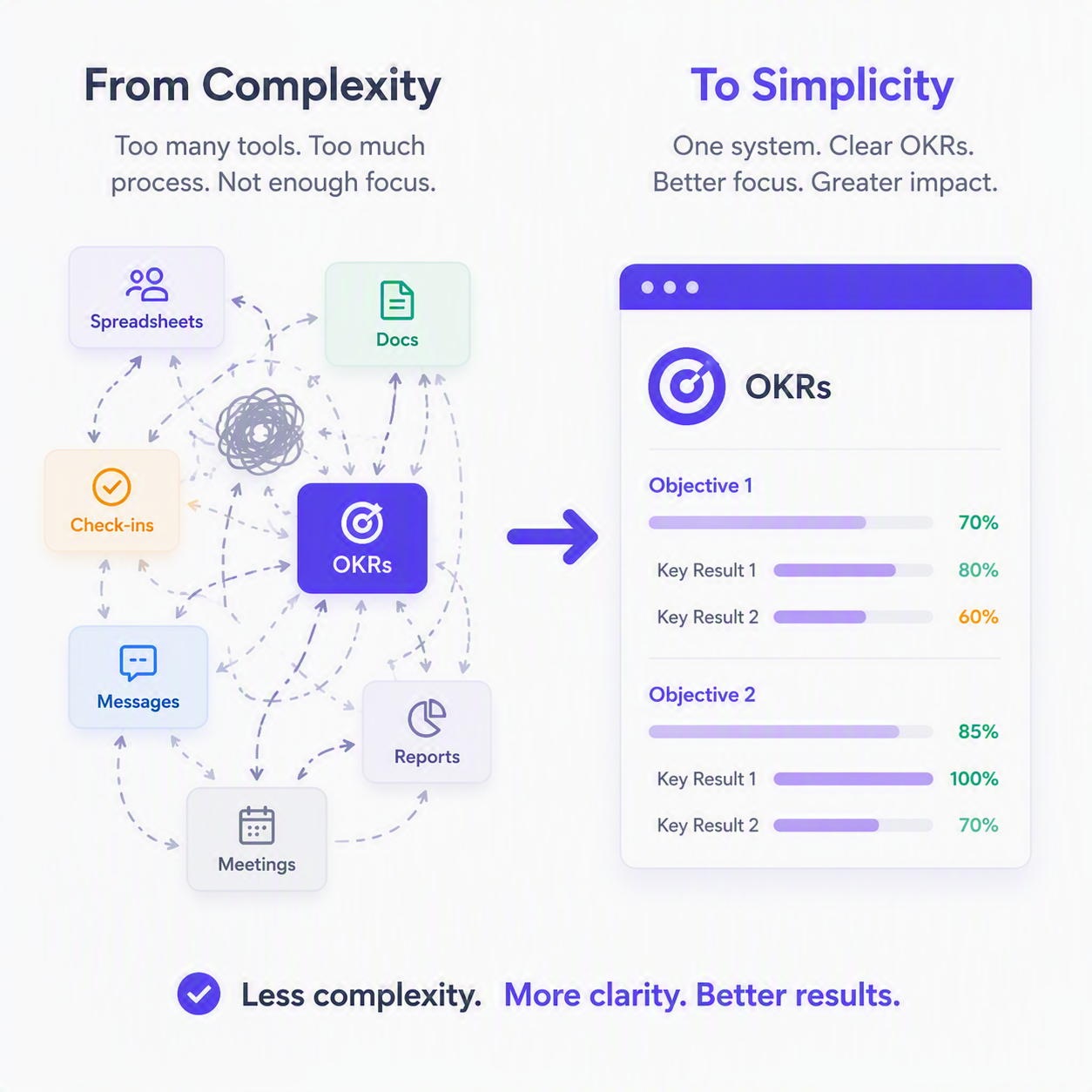
Enterprise tools add fields for every edge case. Consultants sell multi-quarter rollout plans. Best-practice guides prescribe exact scoring formulas and mandate quarterly cycles. Before long, you're not setting goals—you're feeding a bureaucracy.
Teams spend more time debating whether a Key Result is "outcome-oriented enough" than actually driving outcomes. They wait for alignment meetings to make progress. They game scores to look good in reviews. The tool becomes the work.
What Actually Matters
Strip away the complexity and three things remain: clear objectives, measurable key results, and regular progress tracking. That's the core. Everything else is optional.
You don't need rigid quarterly cycles. You don't need cascading hierarchies with perfect alignment. You don't need complex scoring. You need to know what you're trying to achieve, how you'll measure it, and whether you're making progress. That's it. Even Google's own re:Work guide to OKRs reduces the framework to two questions: where do you want to go, and how will you know you're getting there.
The Simplicity Test
Ask yourself: would a new team member understand our OKR process in 10 minutes? If the answer is no, you've over-engineered it.
OKRs should feel effortless to use. If they don't, it's not because the framework is flawed—it's because someone added unnecessary layers. Cut them.
Getting Back to Basics
Use flexible timeframes instead of forcing quarterly cycles. Track outcomes, not activities. Monitor progress continuously so you can adapt fast. Use cycles as optional checkpoints, not mandatory containers. Stop scoring if it's not adding value.
Easy OKR is built on this philosophy. We stripped out the complexity and kept the core: set goals, track progress, stay focused. No enterprise overhead. No bloated features. Just the framework that works, without the friction.
The Real Problem
OKRs don't fail because they're a bad idea. They fail because teams drown in process before they see value. Simplify the system, and suddenly OKRs do what they were always meant to do: help you focus, align, and execute.
The problem isn't OKRs. It's OKR complexity. Fix that, and everything else falls into place.